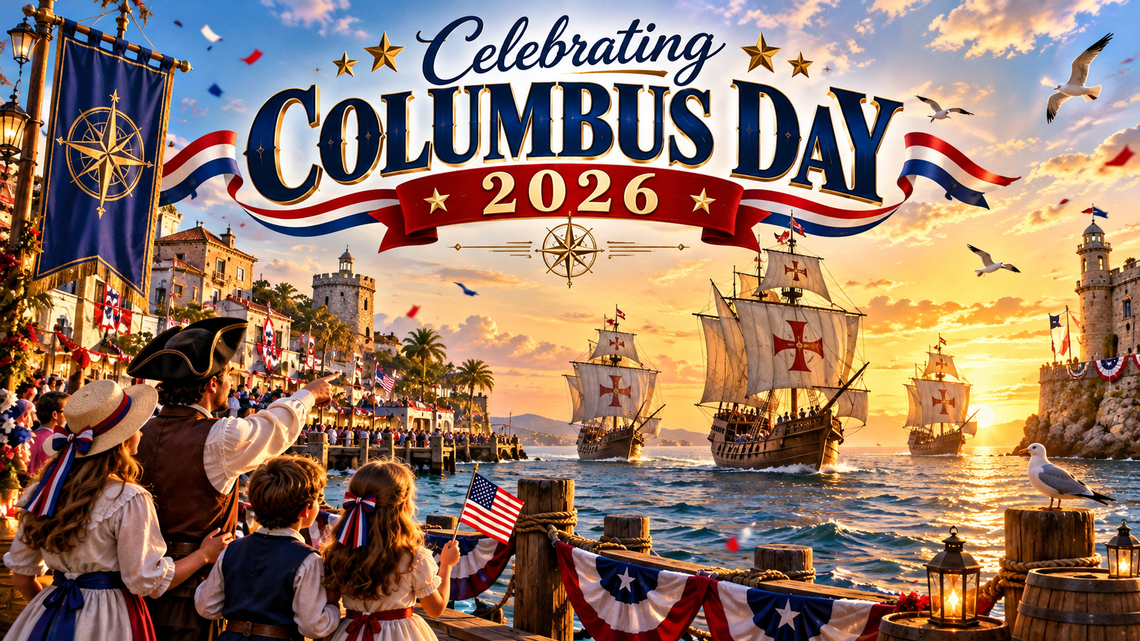
Columbus Day 2026: The History Behind the Holiday and What It Means for Central Florida
Observed Monday, October 12, Columbus Day commemorates Christopher Columbus’s 1492 arrival in the Americas. But the holiday also raises important questions about exploration, Indigenous history and how Americans remember the past.
Every October, Americans encounter a holiday that means different things to different people.
For some, Columbus Day celebrates exploration, maritime achievement and the contributions of Italian Americans.
For others, the date is an opportunity to recognize the Indigenous peoples who lived throughout the Americas long before European ships arrived.
And for many Central Florida residents, the most immediate question is much simpler.
Is the post office open? Are banks closed? And why do we observe Columbus Day in the first place?
This year, Columbus Day falls on Monday, October 12, 2026, exactly 534 years after Christopher Columbus first reached the Caribbean.
Here’s the history behind the holiday, why its meaning has changed over time and what residents should know.
What Happened on October 12, 1492?
On August 3, 1492, Christopher Columbus departed Spain with three ships: the Niña, the Pinta and the Santa María.
Columbus, an experienced navigator from Genoa, was sailing under the sponsorship of the Spanish monarchs Ferdinand and Isabella.
His objective was to find a westward sea route to Asia.
At the time, European merchants sought more direct access to valuable Asian goods, including spices and textiles.
Columbus believed that sailing west across the Atlantic could provide an alternative to the established routes.
But his calculations substantially underestimated the distance involved.
After more than two months at sea, his expedition reached an island in the Bahamas on October 12, 1492.
The island was already inhabited by Indigenous people, commonly identified as Lucayan Taíno.
Columbus named it San Salvador.
The precise location of the island he reached remains a subject of historical debate.
Columbus believed he had reached islands near Asia. He did not understand that the lands he encountered were part of continents previously unknown to most Europeans.
Did Columbus Discover America?
This is where the historical story becomes more complicated.
Columbus did not discover an uninhabited continent.
Indigenous peoples had lived in the Americas for thousands of years before his voyage.
Their societies included sophisticated agricultural systems, cities, trade networks, political institutions and distinctive cultural traditions.
Columbus also was not the first European known to reach North America.
Norse explorers, including Leif Erikson, reached the region around Newfoundland approximately 500 years earlier.
What made Columbus’s voyage historically significant was something different.
His expedition helped establish sustained contact between Europe and the Americas.
That contact transformed world history.
It led to new trade networks, the movement of plants and animals between continents, European colonization and enormous political and economic changes.
It also brought devastating consequences for Indigenous populations, including epidemic disease, warfare, enslavement and displacement.
Both sides of that history are essential to understanding the holiday.
Why Did the United States Create Columbus Day?
Columbus Day was not originally a federal holiday.
Italian American communities played a major role in popularizing commemorations of Columbus during the nineteenth century.
For many Italian immigrants and their descendants, Columbus represented an important historical connection between Italian heritage and American identity.
The holiday also gained national attention in 1892, when President Benjamin Harrison encouraged Americans to commemorate the 400th anniversary of Columbus’s voyage.
That observance occurred during a period when Italian immigrants faced considerable prejudice and discrimination.
Columbus became a prominent symbol of Italian American achievement and belonging.
In 1934, Congress approved a measure requesting an annual presidential proclamation recognizing Columbus Day.
President Franklin D. Roosevelt issued the first such proclamation in 1934.
Columbus Day became a permanent federal holiday under legislation enacted in 1968, with the modern Monday observance taking effect in 1971.
Today, it is observed on the second Monday in October.
Why Do Some Communities Observe Indigenous Peoples’ Day?
In recent decades, communities across the United States have reconsidered how the arrival of Europeans in the Americas should be commemorated.
Indigenous Peoples’ Day recognizes the histories, cultures and continuing contributions of Native American peoples.
It also encourages Americans to examine the consequences of European colonization.
Supporters believe the holiday provides a more complete understanding of American history by recognizing the people who lived here before European contact.
Others believe Columbus Day should be retained because of its historical importance and its longstanding association with Italian American heritage.
Some communities recognize both observances.
The two commemorations reflect different historical perspectives, and understanding their origins helps explain why the holiday continues to generate discussion.
Florida Has Its Own History of European Exploration
Although Columbus never reached Florida, the state’s history is closely connected to the European exploration and colonization that followed his voyages.
In 1513, Spanish explorer Juan Ponce de León reached the Florida peninsula.
He named the region La Florida.
But, like the Caribbean islands Columbus encountered, Florida was already inhabited.
Numerous Indigenous peoples lived throughout the peninsula, including the Timucua, Calusa and Apalachee.
These communities had established settlements, political structures, trade networks and distinct cultures long before Europeans arrived.
The Spanish later established St. Augustine in 1565.
Today, St. Augustine is recognized as the oldest continuously occupied European-established settlement in the continental United States.
For Central Florida residents interested in history, these events are particularly relevant because they help explain how the region became part of the larger colonial history of North America.
Central Florida’s Indigenous History Is Much Older
Long before Orlando existed, Indigenous communities lived throughout Central Florida.
The region’s lakes, rivers, wetlands and forests supported human settlement for thousands of years.
The archaeological record documents Indigenous activity across the region long before European colonization.
Later, during the eighteenth and nineteenth centuries, Seminole communities became an important part of Florida’s history.
The Seminole people emerged from groups that included migrants from the southeastern United States and others who established communities in Florida.
Their resistance to forced removal became a defining chapter in the state’s history.
Today, the Seminole Tribe of Florida and the Miccosukee Tribe of Indians of Florida continue to preserve and share their cultures and histories.
That makes Indigenous history a living part of Florida, not simply something that belongs in a textbook.
Is Columbus Day a Federal Holiday in 2026?
Yes.
Columbus Day is one of the federal holidays recognized by the United States government.
In 2026, the observance falls on Monday, October 12.
Because the holiday happens to fall on the historical anniversary this year, the federal observance and October 12 date coincide.
Federal offices generally close for the holiday.
However, private businesses and local government offices may follow different schedules.
What’s Open and Closed in Orlando?
Here’s what Central Florida residents can generally expect.
USPS: Regular mail delivery and most post office retail operations are suspended for Columbus Day, although Priority Mail Express services may operate.
Banks: Many banks close because Columbus Day is a Federal Reserve holiday. Online banking, ATMs and some branch services may remain available.
Federal offices: Most nonessential federal offices are closed.
Retail stores: Most major retailers, supermarkets and restaurants remain open.
Schools: School calendars vary by district. Families should check their school’s official calendar rather than assume classes are canceled.
City and county offices: Local governments determine their own holiday schedules. A federal holiday does not automatically mean every Orlando or Orange County office closes.
Trash and recycling: Collection schedules depend on the local government or waste provider.
If you have an appointment, delivery or government errand scheduled for October 12, confirm operating hours directly.
Ways to Explore Florida History This Columbus Day
You don’t have to travel to St. Augustine or spend a great deal of money to learn something about Florida’s past.
Central Florida has several museums and cultural institutions that can help residents explore the region’s history.
The Orange County Regional History Center in downtown Orlando offers exhibits covering thousands of years of Central Florida history, including Indigenous cultures, early settlement and the development of modern Orlando.
The Museum of Seminole County History in Sanford provides another opportunity to learn about the region’s earlier communities and local development.
Families can also explore educational resources published by the Seminole Tribe of Florida and the Smithsonian’s National Museum of the American Indian.
Check operating hours before visiting, particularly on a federal holiday.
A Holiday That Encourages Us to Look More Closely at History
History is rarely as simple as a single heroic figure or one event.
Columbus’s 1492 voyage changed the course of world history.
It helped connect continents through trade, migration and cultural exchange on an unprecedented scale.
But it also opened the door to centuries of colonization and profound suffering for Indigenous peoples.
Recognizing those consequences does not require ignoring the navigational achievement of crossing the Atlantic in the fifteenth century.
Likewise, understanding the historical importance of Columbus does not require overlooking the civilizations that existed in the Americas before his arrival.
For many Italian Americans, Columbus Day remains a celebration of heritage and the contributions their communities have made to the United States.
For Indigenous communities, October offers an opportunity to share histories that were often excluded from traditional accounts of American development.
Both perspectives are part of the modern conversation.
And here in Central Florida, where Indigenous history, Spanish exploration and centuries of migration have all shaped the region, the holiday offers an opportunity to learn more about the place we call home.
Perhaps the most useful way to observe Columbus Day is to appreciate the complexity of history and remain curious enough to keep learning.

Hector
Just a guy with a lot of thoughts on a lot different things. This site is where I can share some of those thoughts. I'm in Defense and Aerospace and we will leave it at that.

You May Also Like
Trimble Park Turns 100: Discover One of Orange County’s Hidden Gems
10 Free Things to Do in Orlando This October 2026