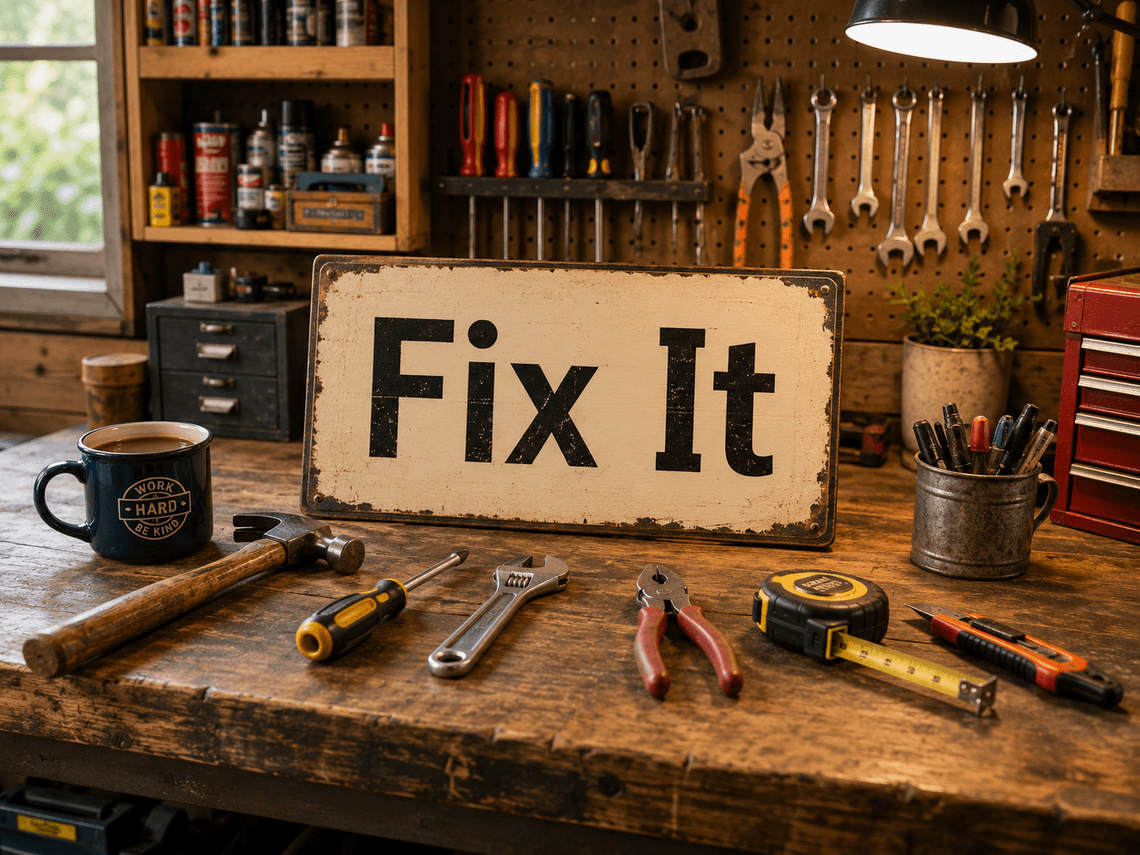
Before You Replace It, Try Fixing It: The Case for Repairing Things Again
Fix it, don’t replace it
We live in a world where replacing a broken product is often easier than repairing it. That convenience may be costing us more than we realize.
Something breaks.
Maybe the washing machine stops draining. Your laptop suddenly refuses to charge. The vacuum cleaner loses suction. A lamp stops working. The coffee maker that worked perfectly yesterday is completely dead this morning.
For many of us, the next step has become almost automatic:
Start shopping for a new one.
That reaction makes sense. Modern consumer products are inexpensive, replacements can arrive tomorrow, and manufacturers do not always make repairs easy.
But before clicking Buy Now, there is another question worth asking:
What actually broke?
Because sometimes a $600 appliance is being thrown away because of a $20 part.
We Have Become a Replacement Economy
Previous generations repaired things partly because they had no choice.
Products were expensive relative to household income, delivery was slow, and replacing an appliance or piece of equipment was a significant purchase.
Today, manufacturing and global distribution have made an extraordinary variety of products relatively inexpensive and immediately available.
That convenience has changed our behavior.
When something stops working, we increasingly evaluate the entire product rather than the failed component inside it.
A washing machine becomes “broken.”
A laptop becomes “dead.”
A vacuum becomes “junk.”
But machines rarely fail all at once.
Usually, one component fails inside an otherwise functional product.
That distinction can potentially save you hundreds of dollars.
Diagnose Before You Shop
The first rule should be simple:
Do not replace anything until you understand what failed.
Suppose your dryer suddenly stops producing heat.
The dryer itself may still be perfectly functional. Depending on its design, the problem could involve a heating element, thermal fuse, thermostat, sensor or another replaceable component.
If your vacuum cleaner stops picking up dirt, the motor may not be failing at all.
The problem might simply be a clogged hose, dirty filter or damaged belt.
A laptop that will not charge might have a failed charger rather than a failed computer.
A refrigerator that suddenly seems warm might have an airflow problem rather than a failed refrigeration system.
None of this means every failure will be inexpensive.
It means you shouldn’t assume the most expensive explanation first.
The Internet Changed DIY Repair
There is another reason repairing things makes more sense today than it did even 20 years ago:
Information is everywhere.
Search for the model number of almost any popular appliance followed by the symptoms you’re experiencing and there is a good chance someone has encountered the same problem.
You may find troubleshooting guides, repair forums, service manuals, exploded diagrams, parts catalogs and videos showing exactly how a component is replaced.
This has dramatically reduced one of the biggest historical barriers to DIY repair: knowledge.
You no longer necessarily need to understand an entire washing machine.
You need to understand why this particular washing machine isn’t draining.
Those are very different problems.
Start With the Model Number
If you want to troubleshoot something, find its exact model number.
Not just the brand.
Not “Samsung refrigerator.”
Not “Dyson vacuum.”
The exact model.
Manufacturers frequently produce dozens of versions of products that look almost identical externally but contain different components.
Once you have the model number, search for:
Model number + symptom
For example:
ABC123 washer won’t drain
or
XYZ456 refrigerator not cooling
Then compare several sources rather than trusting the first answer you encounter.
You’re looking for patterns.
If many owners report the same symptoms and the same failed component, you may have found a known weakness in that product.
Sometimes the Repair Is Ridiculously Simple
One of the strangest aspects of modern consumer products is how inexpensive the failed component can be compared with the value of the machine.
A switch.
A fuse.
A belt.
A relay.
A capacitor.
A hose.
A connector.
A sensor.
A battery.
Any one of these relatively small components can disable a much more expensive device.
Imagine replacing a $300 vacuum cleaner because a $12 belt broke.
That sounds absurd when stated that way.
But consumers effectively do versions of this every day because we usually cannot see the failed component.
We only see that the product no longer works.
But Know When to Stop
Repair culture shouldn’t become an obsession either.
There are products that simply aren’t worth repairing.
If a ten-year-old television requires a $400 repair and a substantially better replacement costs $500, replacement probably makes more sense.
If an appliance has already experienced several major failures, another repair may simply postpone the inevitable.
There are also situations where repair involves significant safety risks.
Microwave ovens, high-voltage electronics, gas appliances, refrigeration systems, large capacitors and mains-powered equipment can contain hazards that remain dangerous even after the product has been unplugged.
Knowing when not to attempt a repair is part of repairing things intelligently.
Sometimes the best DIY diagnosis ends with:
I know what’s wrong, and I’m calling a professional.
That’s still useful information.
Calculate the Repair Ratio
A simple rule can help.
Compare the total realistic repair cost with the cost of replacement.
Suppose you own an appliance worth roughly $800 to replace.
If repairing it costs $100, the decision is easy.
At $250, repair may still make sense.
At $500, the decision becomes much harder, particularly if the appliance is already old.
Age matters because repairing one component does not make the rest of the product new.
A ten-year-old refrigerator receiving a $600 repair still contains ten-year-old compressors, fans, seals, electronics and mechanical components.
Sometimes replacing the entire machine really is the smarter financial decision.
The important point is to make that decision using numbers rather than frustration.
Repairability Should Affect What We Buy
There is another lesson here that applies before anything breaks.
When shopping for expensive products, we should start considering repairability as part of the purchase decision.
Can replacement parts be purchased?
Can the battery be replaced?
Does the manufacturer provide documentation?
Are independent repair shops able to service it?
Are common components modular, or is everything permanently bonded together?
How long does the manufacturer typically provide parts?
A product that costs $50 more but can realistically be maintained for ten years may be much cheaper than a disposable alternative that has to be replaced every three.
Repairability is a feature.
We should start treating it like one.
Right-to-Repair Is Becoming a Bigger Issue
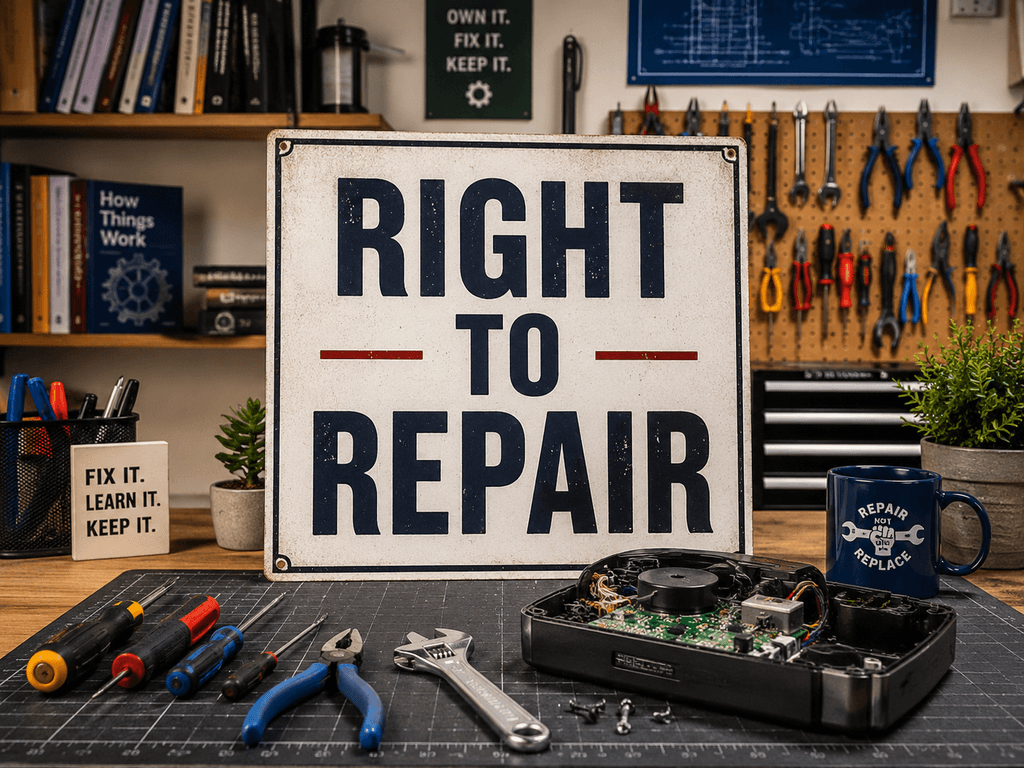
Repairability has also become a significant consumer-policy issue.
The Federal Trade Commission’s repair-restrictions information describes how repair restrictions can increase consumer costs and limit independent repair options. The FTC has previously reported to Congress that it found “scant evidence” supporting many manufacturer justifications for repair restrictions.
States have increasingly adopted right-to-repair laws covering various categories of electronics and equipment, while the exact requirements differ considerably from state to state.
The issue isn’t really about forcing everyone to repair their own electronics.
It is about whether the person who purchased a product should have reasonable options for keeping it working.
That could mean repairing it yourself.
It could mean using an independent technician.
Or it could simply mean having access to replacement parts long enough for a professional to repair it.
Repair Has an Environmental Benefit Too
There is another consequence every time we replace something unnecessarily.
The old product has to go somewhere.
Electronics and appliances contain plastics, metals, circuit boards, motors, batteries, glass and numerous other materials that required energy and resources to manufacture.
Recycling helps, but recycling is not magic.
The U.S. Environmental Protection Agency continues to encourage electronics donation and recycling, noting that recycling electronics conserves natural resources and helps avoid pollution associated with extracting and processing raw materials.
But there is an even simpler option when practical:
Keep using the product you already have.
Extending the useful life of something by another three or five years means another replacement doesn’t have to be manufactured for you yet.
There Is Also Something Satisfying About Fixing Things
The financial argument is easy to understand.
But there is another benefit that is harder to quantify.
Repairing something feels good.
You start with an object that doesn’t work.
You investigate.
You form a theory.
You take it apart.
You find the problem.
You replace or repair something.
Then you press the button.
And it works.
There is a particular kind of satisfaction in that moment because you didn’t simply purchase the solution.
You understood the problem.
That mindset carries over into other parts of life.
You become less intimidated by machines.
You start asking how things work.
You become more comfortable troubleshooting.
Eventually, a broken product stops automatically looking like garbage and starts looking like a problem that might have a solution.
Create a Simple Repair Rule
The next time something breaks, try this before replacing it:
- Find the exact model number.
- Identify the symptoms.
- Search for common failures associated with those symptoms.
- Determine the likely part and repair cost.
- Check whether the repair can be performed safely.
- Compare the total repair cost with replacement.
- Consider the product’s age and overall condition.
- Then decide.
Sometimes the conclusion will still be:
Buy a new one.
That’s perfectly reasonable.
But other times you may discover that the expensive machine you were preparing to throw away needs a screwdriver, 30 minutes and a $17 replacement part.
And when that happens, you haven’t just saved money.
You’ve kept something useful out of the trash and learned something in the process.
Maybe the old habit of fixing things wasn’t so old-fashioned after all.

Hector
Just a guy with a lot of thoughts on a lot different things. This site is where I can share some of those thoughts. I'm in Defense and Aerospace and we will leave it at that.


You May Also Like

New Lake Nona Park Planned With Splash Pad, Pickleball and Trails

Your Car Is Becoming a Subscription: How to Avoid Paying Forever for Features You Already Bought