Your Car Is Becoming a Subscription: How to Avoid Paying Forever for Features You Already Bought
How to avoid the subscriptions on your next car
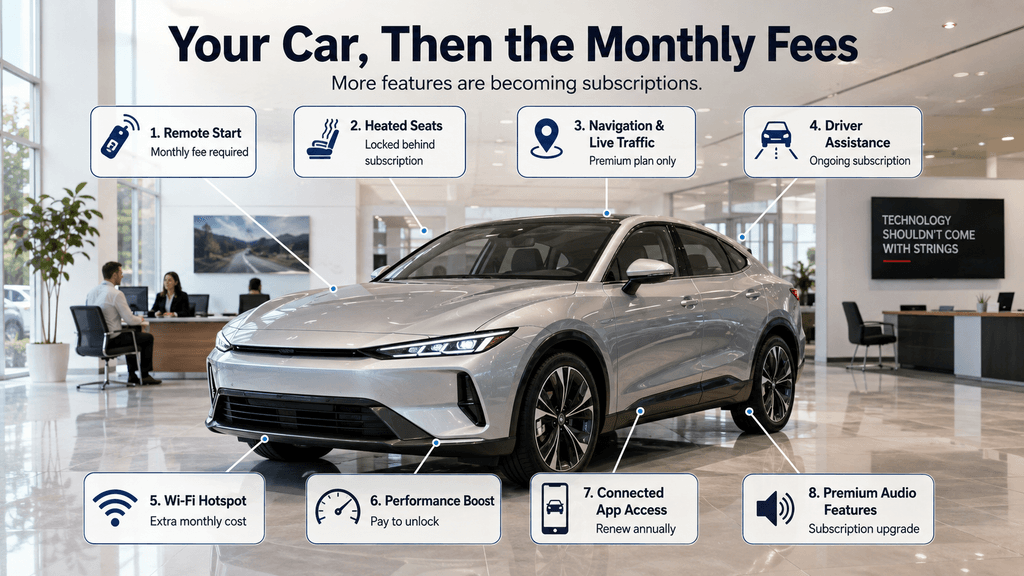
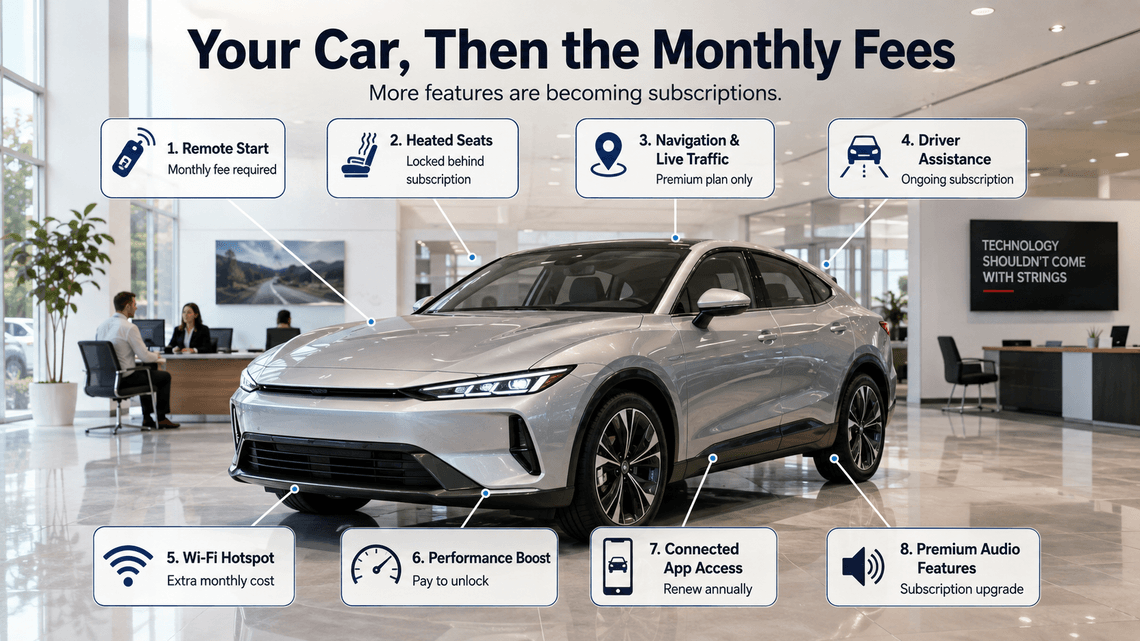
Automakers have discovered recurring revenue. Remote start, navigation, hands-free driving and other features can now come with monthly bills long after the car payment begins. Here’s how to recognize the subscription trap—and which manufacturers currently give buyers better alternatives.
Buying a car used to be relatively straightforward.
You selected the engine.
You picked the trim.
Maybe you paid extra for leather seats, a sunroof, navigation or a better stereo.
Then you drove away.
The equipment installed in the vehicle was yours.
Increasingly, that isn’t how automobiles work.
Modern vehicles are becoming computers on wheels, and automakers have realized that software allows them to continue selling things to us after we have already purchased the car.
Remote start.
Navigation.
Vehicle location.
Hands-free highway driving.
Internet connectivity.
Performance upgrades.
Climate controls.
Entertainment.
Some of these subscriptions are perfectly reasonable because the manufacturer is actually providing an ongoing service.
Others raise a much more uncomfortable question:
If the hardware is already installed in the car I bought, why am I still paying to use it?
That distinction is going to become increasingly important for anyone shopping for a new vehicle.
And here in Central Florida, where remote climate control can be genuinely useful when your car has been sitting in a 95-degree parking lot, losing remote-start capability when a free trial expires isn’t exactly a trivial inconvenience.
Automakers Have Discovered Recurring Revenue
The subscription economy has already transformed software, entertainment and consumer electronics.
Now it is coming for automobiles.
The basic business case is obvious.
Suppose an automaker sells you a vehicle and earns its profit once.
That relationship could effectively end when you leave the dealership.
But if the company can sell you $15, $30 or $50 worth of services every month for the next eight years, the same vehicle continues producing revenue long after it was sold.
That’s extremely attractive to manufacturers.
AARP recently examined the trend and described the experience of a Mazda3 owner who had used an app to remotely lock and unlock his vehicle, locate it and view vehicle information. After the complimentary period ended, continuing the connected service required a monthly payment. He simply decided the features weren’t worth paying for. (AARP)
That may increasingly become one of the most important questions car buyers ask:
What happens when all my free trials expire?
Not Every Vehicle Subscription Is Unreasonable
There is an important distinction to make before declaring every automotive subscription a rip-off.
Some services really do have ongoing costs.
If your vehicle receives constantly updated high-definition maps, cellular data, live traffic information, a Wi-Fi connection, concierge assistance or cloud-based services, somebody has to maintain the servers, cellular connections and information supporting them.
GM’s Super Cruise, for example, depends partly on continuously maintained mapping and connectivity. Chevrolet currently includes three years with equipped vehicles and then charges $39.99 per month for the required plan. (Chevrolet)
You may still decide $39.99 is too expensive.
But at least there is an identifiable continuing service behind the charge.
The situation feels considerably different when a feature is physically installed in the car and requires little or no continuing service from the manufacturer.
That’s where consumers have pushed back.
BMW Learned Where Consumers Draw the Line
BMW became the poster child for automotive subscriptions after experimenting in some international markets with charging owners to activate heated seats already physically installed inside the vehicle.
Consumers hated the idea.
BMW eventually abandoned the heated-seat subscription model. Company executives acknowledged that customers felt as though they were paying twice for the same equipment. BMW shifted its subscription strategy toward software and connected services instead. (Bloomberg)
That episode is important for another reason.
Consumer resistance worked.
Automakers are still figuring out how far customers will allow this business model to go.
If buyers consistently reject vehicles whose ordinary features require recurring payments, manufacturers will notice.
Toyota Shows Why You Need to Read the Fine Print
Toyota offers a good example of how complicated connected-car ownership has become.
Toyota’s current Connected Services plans start at $15 per month on applicable vehicles. Remote Connect—which can provide remote starting, door locking and unlocking, vehicle location and other features—is bundled into its paid plans. (Toyota)
What makes this particularly noteworthy is that Toyota says Remote Connect can operate through either the smartphone app or the vehicle’s key fob when an active trial or paid subscription is present. (Toyota)
That is exactly the kind of detail consumers need to investigate before purchasing a vehicle.
Fifteen dollars doesn’t sound like much.
But it is:
$180 per year.
Keep paying for five years and you have spent:
$900.
And that is on top of the price of the vehicle.
Kia Has a Similar Tiered Model
Kia Connect currently has several levels.
Its Plus package—which includes features such as remote lock/unlock, remote climate control and Find My Car—is listed at $14.99 per month or $149 annually after applicable complimentary periods.
The Ultimate tier costs $19.99 per month or $199 annually. (Kia Owners Portal)
Choose the annual Plus plan for five years and that is another:
$745.
Again, the individual payment looks small.
The long-term number looks different.
Advanced Driver Assistance Is Becoming One of the Biggest Subscription Categories
Automakers appear to be increasingly comfortable charging recurring fees for advanced driver-assistance systems.
Ford’s BlueCruise currently offers three choices on eligible vehicles:
$49.99 monthly
$495 annually
or a $2,495 one-time purchase. (https://www.ford.com/)
That last option is interesting because it gives buyers a way out of the permanent subscription.
At $495 per year, five years costs $2,475.
So if you intend to keep an eligible vehicle considerably longer than five years and regularly use BlueCruise, the one-time purchase could eventually become the better deal.
That is exactly the kind of calculation consumers should make.
Do not ask:
“Can I afford $49.99 this month?”
Ask:
“What will this feature cost me over the time I expect to own the car?”
Tesla Has Gone Completely Subscription-Based for FSD
Tesla currently charges $99 per month for Full Self-Driving (Supervised).
More significantly, Tesla’s current U.S. support page says FSD (Supervised) is not available for outright purchase and is subscription-only. (Tesla)
That means someone keeping the subscription continuously would pay approximately:
$1,188 per year.
Over five years:
$5,940.
Of course, you don’t have to subscribe.
And that may be the best defense against this entire trend.
If an optional feature isn’t worth the continuing cost, leave it turned off.
Rivian Is Building Subscriptions Into the Ownership Model Too
Rivian currently offers Connect+ for $14.99 per month or $149.99 annually, providing additional streaming and connectivity features.
It also offers Autonomy+ at $49.99 per month for eligible driver-assistance capabilities. (Rivian)
Again, these are optional.
But car buyers increasingly need to consider recurring software costs alongside fuel, insurance and maintenance.
The monthly vehicle payment is no longer necessarily the only monthly payment associated with owning the car.
So Which Automakers Are Better If You Hate Subscriptions?
Finding a completely subscription-free modern vehicle is becoming difficult.
Satellite radio, cellular hotspots and connected applications appear across almost every manufacturer’s lineup.
A more realistic goal is to find a vehicle where the features you care about continue working without another monthly payment.
Several current examples stand out.
Hyundai Is One of the Better Choices Right Now
Hyundai’s Bluelink+ program is unusually consumer-friendly compared with many competitors.
For original purchasers and lessees of new Bluelink-equipped Hyundai vehicles beginning with model year 2024—as well as the 2023 IONIQ 6—Bluelink+ is provided at no additional cost for the original owner.
That includes features such as:
- remote start;
- remote door locking and unlocking;
- vehicle information;
- EV charging controls on applicable vehicles;
- diagnostics and connected services.
There are exceptions by model and trim, and Hyundai says map and multimedia over-the-air updates can carry fees after an initial three-year period. But the core Bluelink+ arrangement is significantly better than paying indefinitely for remote-start capability. (Hyundai USA)
A 2026 Hyundai Santa Fe, for example, participates in the Bluelink+ ecosystem when appropriately equipped. (Hyundai USA)
For someone buying new and planning to keep the vehicle for a long time, that deserves consideration.
Genesis May Be Even Better for the Original Owner
Genesis has gone further.
The company states that first owners of 2023 and newer Genesis models receive complimentary Genesis Connected Services with no expiration date.
Those services include remote start with climate control, roadside assistance, stolen-vehicle recovery and other connected capabilities. (Genesis)
That applies across current Genesis models for qualifying first owners rather than being limited to one specific vehicle.
There is an important catch:
The benefit is tied to the original owner or lessee.
Used-car buyers should therefore verify exactly what transfers before assuming they will receive the same benefits.
Still, for someone buying a new vehicle, Genesis currently offers one of the strongest answers to the subscription problem.
Ford Gives You Free Remote Functions
Ford is another interesting case.
Yes, Ford sells subscriptions.
BlueCruise is one.
Connected navigation and other services can also cost money.
But Ford currently states that basic Ford app features such as remote start/stop, door locking and unlocking and Phone-as-Key on compatible vehicles are free.
There is no recurring fee simply to use those basic remote functions. (https://www.ford.com/)
That’s a meaningful distinction.
It means someone who just wants to start the air conditioning before walking across an Orlando parking lot doesn’t necessarily need a permanent subscription.
You can simply ignore the optional paid connected services if you don’t value them.
And if you really want BlueCruise, Ford at least offers the one-time purchase alternative on eligible vehicles. (https://www.ford.com/)
Nissan Shows Another Way Around the Problem: Use the Key Fob
The 2026 Nissan Frontier provides an interesting example of how consumers can choose equipment strategically.
Nissan says basic smartphone integration—including Apple CarPlay, Android Auto and Bluetooth—works without a subscription.
NissanConnect remote app services require a subscription after the applicable trial. (Nissan USA)
But certain Frontier trims have key-fob remote start.
Nissan’s specifications show it standard on the 2026 Frontier PRO-X and PRO-4X and available on some other configurations. (Nissan USA)
That means a buyer primarily concerned with remote starting doesn’t necessarily need the paid smartphone service.
Push the button on the key.
Start the truck.
Problem solved.
Sometimes the best technology for defeating a subscription is surprisingly old-fashioned.
BMW Is More Nuanced Than Its Reputation
BMW deserves a second look because the heated-seat controversy has given it a reputation that isn’t entirely representative of its current U.S. strategy.
BMW currently charges for its Digital Premium package, with pricing starting around $9.99 per month on compatible vehicles.
But BMW says core features such as Remote Services, Apple CarPlay, Android Auto and Digital Key remain available as long as technically supported on many newer vehicles. (BMW USA FAQ)
BMW still offers paid software upgrades.
But the company clearly learned that charging people repeatedly to activate basic physical hardware produces a very different reaction from charging for cloud services.
That is progress.
What I Would Ask the Dealer Before Buying Any New Car
This may eventually need to become part of everyone’s car-shopping routine.
Before signing anything, ask the salesperson:
Which features in this car require subscriptions?
Then ask:
Which currently free features will stop working when the trial expires?
Do not accept:
“Don’t worry about it. Everything is free for the first three years.”
That isn’t the question.
Ask what happens in year four.
Get the answer in writing when possible.
Calculate an Eight-Year Ownership Cost
Modern vehicles are expensive enough that many people keep them for a long time.
So calculate subscription costs accordingly.
A $15 monthly subscription looks insignificant next to a $45,000 vehicle.
But eight years of $15 payments is:
$1,440.
A $40 subscription becomes approximately:
$3,840.
And $99 per month becomes:
$9,504.
That changes the conversation.
A useful rule is to multiply every monthly automotive subscription by 96 months when comparing vehicles you expect to keep for eight years.
Suddenly the “little” fees don’t look so little.
Use Apple CarPlay or Android Auto Instead of Paying for Navigation
This may be one of the easiest ways to avoid connected-service charges.
If your car supports Apple CarPlay or Android Auto, your phone already provides:
Google Maps.
Apple Maps.
Waze.
Traffic information.
Music.
Podcasts.
Messaging.
Voice control.
You may have little reason to pay the manufacturer every month for a proprietary navigation or streaming service.
The phone is already doing the job.
Prefer Key-Fob Remote Start
This is particularly relevant in Florida.
Remote start and climate preconditioning are genuinely useful here.
But do you need to start your vehicle from three states away?
Probably not.
For most people, a key fob that starts the vehicle from across a parking lot accomplishes what they actually need.
When comparing trims, ask specifically:
Does remote start work from the key fob without an active connected-services subscription?
That single question could save you hundreds of dollars over the life of the car.
Do Not Give the Dealer a Credit Card Just Because the Trial Is Free
Free trials are one of the oldest subscription tricks in existence.
Three months free.
One year free.
Three years free.
Then the billing starts.
If enrollment requires a payment method, determine whether automatic renewal is enabled.
Set a calendar reminder well before expiration.
Better yet, if you don’t actually need the service, don’t activate it simply because it is free.
A free feature that becomes part of your daily routine is much harder to give up three years later.
Automakers understand that.
Used-Car Buyers Need to Be Especially Careful
Subscription terms can change when ownership changes.
That matters with programs such as Hyundai Bluelink+ and Genesis Connected Services, where the most generous benefits apply specifically to the original owner.
A used car sitting on a dealer lot may physically contain exactly the same hardware as it did when new while having completely different connected-service terms.
Before buying used, check the vehicle identification number with the manufacturer’s connected-services website.
Ask:
What is permanently included?
What trial remains?
What transfers?
What requires payment?
You do not want to discover the answer after buying the vehicle.
Don’t Hack Around a Software Lock
There will inevitably be businesses offering ways to defeat software restrictions.
That is not the strategy I would recommend.
Unauthorized software modifications can create warranty problems, cybersecurity issues and potentially interfere with systems integrated with other vehicle electronics.
The better workaround is economic.
Don’t buy the subscription.
Or don’t buy the vehicle.
That sends a much clearer message to the manufacturer.
The Consumer Still Has More Power Than It Seems
The BMW heated-seat story demonstrated something important.
Automakers are experimenting.
They don’t actually know how much subscription behavior consumers will tolerate.
We determine that.
If buyers continue paying $15 every month to unlock features they believe should be part of the vehicle, manufacturers will conclude that the model works.
If customers start asking dealerships about subscription costs, favor manufacturers offering permanent functionality and reject cars with excessive recurring fees, those decisions eventually appear in sales data.
And automakers pay very close attention to sales data.
The Best Subscription Is the One You Never Needed
There are connected automotive services worth paying for.
Maybe Super Cruise dramatically improves your long-distance commute.
Maybe you genuinely use remote vehicle monitoring every day.
Maybe built-in navigation is worth the convenience.
That’s fine.
The problem isn’t subscriptions themselves.
The problem is allowing subscriptions to become the default method of accessing ordinary functionality inside something we already spent tens of thousands of dollars to own.
A $15 payment is easy to ignore.
So is $20.
So is $40.
But add them to your streaming subscriptions, software subscriptions, cloud storage, phone service, internet service and everything else already reaching into your bank account each month and the direction becomes obvious.
The automotive industry would love to turn your driveway into another source of recurring revenue.
You don’t have to cooperate.
Before buying your next car, don’t just ask about horsepower, fuel economy and warranty coverage.
Ask one more question:
When I finish paying for this car, which parts of it will I still have to keep paying to use?
The answer may tell you more about the vehicle than anything printed on the window sticker.
Current Subscription Examples at a Glance
| Manufacturer/service | Current recurring cost | A way to minimize or avoid it |
|---|---|---|
| Toyota Connected Services | Plans from about $15/month | Decide whether app remote features are worth it; verify key-fob functionality before buying. (Toyota) |
| Kia Connect Plus | $14.99/month or $149/year | Use lower/free tier if you don’t need remote climate and app controls. (Kia Owners Portal) |
| Ford BlueCruise | $49.99/month or $495/year | Eligible vehicles offer a $2,495 one-time purchase; Ford’s basic app remote controls remain free on compatible vehicles. (https://www.ford.com/) |
| GM Super Cruise | $39.99/month after included period | Decline renewal if you don’t value hands-free driving. (Chevrolet) |
| Tesla FSD (Supervised) | $99/month | Simply don’t subscribe if the feature isn’t worth $1,188/year to you. (Tesla) |
| Rivian Connect+ | $14.99/month or $149.99/year | Use standard vehicle connectivity if premium streaming features aren’t necessary. (Rivian) |
| Hyundai Bluelink+ | No added charge for qualifying original owners | One of the better current choices for buyers wanting connected remote features without another monthly bill. (Hyundai USA) |
| Genesis Connected Services | Complimentary with no expiration for qualifying first owners | Particularly attractive for buyers planning long-term ownership. (Genesis) |
Prices and offerings are current as of August 2026 and can change by model, trim, model year and manufacturer.

Hector
Just a guy with a lot of thoughts on a lot different things. This site is where I can share some of those thoughts. I'm in Defense and Aerospace and we will leave it at that.


You May Also Like

New Lake Nona Park Planned With Splash Pad, Pickleball and Trails

Hispanic Heritage Month Orlando 2026: Free Events, Food & Culture