Orlando Dreamers MLB Bid: Is Major League Baseball Worth the Cost for Orlando?
The Orlando Dreamers say Central Florida is ready for the big leagues. Orlando may have the population, tourists and economic scale to support MLB, but the harder question is whether bringing a team here is worth nearly $1 billion in proposed public support.
For years, Orlando has had an unusual place in American professional sports.
We have the Orlando Magic.
We have Orlando City SC.
We have the Orlando Pride.
We host major college football games, bowl games, international soccer, large amateur sports events and seemingly every type of sports tournament imaginable.
Yet one of America’s traditional major professional sports remains conspicuously absent:
Major League Baseball.
The Orlando Dreamers want to change that.
The organization created by the late Orlando Magic co-founder Pat Williams has developed into a serious effort to position Orlando for a future MLB expansion franchise. Hall of Famer Barry Larkin and former Major League players Johnny Damon and David Eckstein are among the recognizable baseball figures involved in promoting the effort.
And this is no longer simply a hypothetical discussion about whether baseball might someday work in Orlando.
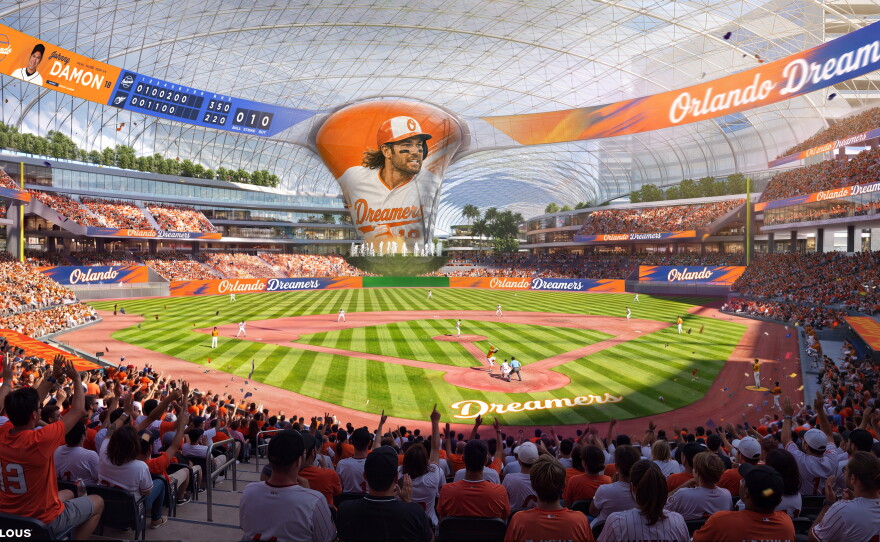
The Dreamers have identified a stadium location, released architectural concepts, assembled prospective private financing and recently asked Orange County for $975 million in Tourist Development Tax support toward a proposed domed ballpark.
That makes this a legitimate public-policy question for Central Florida:
Would Major League Baseball be good for Orlando, and is it worth the price?

What Exactly Are the Orlando Dreamers Proposing?
The current concept centers on a roughly 45,000-seat covered stadium on a 35.5-acre site in Orlando’s tourism corridor near International Drive, State Road 528 and Aquatica.

The surrounding development is envisioned as considerably more than a baseball stadium. Renderings show hotels, restaurants, retail, offices, cultural attractions and event spaces intended to operate throughout the year.
Earlier versions of the stadium were estimated at around $1.7 billion. The Dreamers’ current public financing request calls for Orange County to provide $975 million, historically contemplated through long-term bonds backed by Tourist Development Tax revenue, while private investors would provide the balance of stadium construction financing. Separate private financing would be necessary to acquire an expansion franchise.
The Dreamers say they now have more than $2 billion in letters of intent from private financial partners covering stadium and team-acquisition financing. It is worth emphasizing the wording: letters of intent demonstrate potentially serious financial interest, but they are not the same thing as $2 billion already sitting in an irrevocable account waiting to be spent.
The Situation Changed This Week
For years, one possible path to Orlando baseball involved the Tampa Bay Rays.
That now looks substantially less likely.
On August 28, Hillsborough County commissioners approved financing for a new Tampa stadium after Tampa City Council approved the deal. The roughly $2.36 billion Rays project includes approximately $1.37 billion from the team, $796 million from Hillsborough County and $80 million from Tampa, with the Rays responsible for cost overruns. The agreement includes a 35-year lease and no-relocation provision.
Assuming that project proceeds, Orlando’s realistic route to Major League Baseball is therefore expansion, not taking the Rays from Tampa Bay.
That may actually make the Orlando debate cleaner.
The question becomes whether MLB eventually grows from 30 to 32 franchises and whether Orlando can beat other contenders such as Nashville, Portland, Salt Lake City, Raleigh and others for one of those spots.
Commissioner Rob Manfred has repeatedly expressed interest in having an expansion process underway before his term ends in January 2029, although MLB has not yet formally awarded expansion franchises and the timing remains uncertain.
So Orlando is preparing for a competition that has not officially started.
The Best Argument for Orlando: This Is a Very Large Market
The strongest argument for Major League Baseball in Orlando may actually have very little to do with stadium renderings.
It is simply that Central Florida has become enormous.
The Orlando-Kissimmee-Sanford metropolitan area had an estimated 2,957,672 residents in 2025, according to the U.S. Census Bureau. The region added nearly 38,000 people in just one year and ranked among America’s largest metro areas for numeric population growth.
That is not a small-market city attempting to convince a major league that it can somehow grow into the role.
Greater Orlando is already approaching three million residents.
And the potential fan base extends into rapidly growing communities throughout Orange, Osceola, Seminole, Lake, Polk, Volusia and surrounding counties.
That gives the Dreamers’ market argument legitimate weight.
Then Orlando Has Something Almost No Other Candidate Has
Tourists.
Lots of them.
The Dreamers argue that Orlando’s enormous visitor economy fundamentally changes the mathematics of Major League Baseball.
Their promotional material estimates approximately 80 million annual visitors and makes an eye-catching argument: if only 4% of them attended one baseball game, that would produce 3.2 million admissions.
Mathematically, that’s true.
But it is also worth examining what that would mean.
A team drawing 3.2 million fans over 81 home games would average roughly:
39,500 people per game.
That would make Orlando one of Major League Baseball’s strongest attendance markets almost immediately.
Possible?
Yes.
Something taxpayers should automatically assume will happen?
No.
People coming to Orlando already have an extraordinary number of ways to spend their vacation time and money. Baseball would be competing with Disney, Universal, SeaWorld, conventions, restaurants, shopping, concerts and dozens of other attractions.
The tourist market is therefore a genuine Orlando advantage.
But converting millions of visitors into baseball ticket buyers is not automatic.
A Stadium in the Tourism District Actually Makes Sense
If Orlando were going to build an MLB stadium, however, the Dreamers’ preferred general location has logic behind it.
Putting it near International Drive places baseball close to the Orange County Convention Center, hotels, major attractions and the region’s tourism infrastructure.

That matters because tourists would not need to venture far from where they are already staying.
A visitor attending a convention could catch an evening baseball game.
A family could incorporate baseball into a vacation.
Fans traveling to see the Yankees, Red Sox, Cubs or Dodgers could potentially build an Orlando vacation around an away series.
And unlike an NFL stadium with eight or nine regular-season home games, baseball generates 81 home dates every season.
Add concerts and other events and the stadium could theoretically remain active much more frequently.
That is a legitimate economic advantage.
The Surrounding Businesses Could Benefit
There is also evidence that baseball stadiums can produce localized economic benefits.
Research examining businesses near major-league sports facilities found that baseball attendance generated measurable additional visits to nearby restaurants, hotels and retailers. The effect was particularly noticeable for food and accommodations.
That supports one of the better arguments for the Dreamers’ mixed-use concept.
Restaurants, hotels and entertainment built immediately around a successful stadium may indeed benefit substantially from tens of thousands of people arriving repeatedly.
The distinction, however, is important:
A stadium can strongly benefit the area immediately around it without generating equally dramatic economic growth across all of Orange County.
Those are two different claims.
The Dreamers Are Projecting Very Large Economic Benefits
The Dreamers commissioned JLL to update an economic-impact analysis of their proposal.
They say the project could produce:
- more than 38,000 construction-phase jobs
- more than 52,000 permanent jobs
- more than $72 billion in economic activity over 30 years
- roughly $32 million in additional annual Tourist Development Tax revenue.
Those are enormous numbers.
They deserve to be part of the conversation.
But they should be treated as projections, not guaranteed outcomes.
Economic-impact studies generally make assumptions about visitor spending, employment, multiplier effects, substitution and the amount of economic activity that would not otherwise have occurred.
Change those assumptions and the result can change significantly.
And this is where the economic literature on publicly funded stadiums becomes considerably less enthusiastic.
Economists Have Been Skeptical of Stadium Subsidies for Decades
There is a surprisingly broad consensus among economists studying professional sports facilities.
The basic conclusion is not that stadiums create no economic activity.
Obviously they do.
People work there.
Fans spend money.
Restaurants fill up.
Hotels may receive additional guests.
The issue is whether all that activity produces enough new economic growth to justify very large public subsidies.
A comprehensive review covering more than 130 studies found that the overall economic impact of professional sports franchises and venues on metropolitan economies tends to be limited, and that benefits generally fall well short of large public expenditures.
Earlier research published by the American Economic Association reached similar conclusions about claims that stadiums produce major local economic growth.
That doesn’t prove Orlando’s project would fail.
Orlando’s tourism economy is unusual enough that its economics could differ from a typical American city.
But it does mean claims of tens of billions of dollars in economic impact deserve rigorous independent scrutiny before nearly $1 billion in public financing is committed.
And $975 Million Is Still Public Money
One argument frequently made in Orlando’s tourism debates is that Tourist Development Tax money isn’t coming out of residents’ property-tax bills.
That is largely correct.
Orange County’s TDT is a 6% tax on hotel rooms and other short-term accommodations, and visitors generate most of the revenue.
Orange County collected a record $384.6 million in fiscal year 2024-25.
There is another important point that often gets lost in this argument.
Under current Florida law, Orange County generally cannot simply take that TDT money and spend it on ordinary government services such as schools, routine road maintenance, housing or public safety. Its permitted uses are primarily tourism-related.
So saying, “Spend the baseball money on teachers instead,” is not currently a straightforward alternative.
But that does not mean TDT money has no opportunity cost.
Nearly $1 billion committed to baseball is nearly $1 billion that cannot be used for other eligible tourism, cultural, environmental, convention or public-venue projects.
And Orange County has plenty of those competing for money.
Orange County Has Already Shown Some Skepticism
That is not theoretical anymore.
The Dreamers recently requested $975 million from Orange County’s Tourist Development Tax Citizen Advisory Task Force.
The task force declined to recommend the proposal.
On August 25, the Orange County Commission accepted the task force recommendations and directed staff to continue working on the projects that advanced. The Dreamers stadium was not among them.
That does not necessarily kill Orlando’s MLB effort permanently.
But it is a significant political setback to the current financing plan.
And one task-force member summarized the concern rather clearly during the Dreamers presentation: if the county commits $975 million while projected additional TDT revenue is approximately $32 million annually, does that represent an adequate return on the public investment?
That is exactly the question residents should be asking.
Do Orlando Residents Actually Want Baseball?
This is where the story becomes particularly interesting.
There is a major difference between asking:
Would you like Orlando to have a Major League Baseball team?
and asking:
Would you like Orange County to spend nearly $1 billion helping build its stadium?
Those questions can produce very different answers.
There are good reasons to believe Orlando could have a substantial baseball audience.
The metropolitan population is large and growing.
Central Florida has strong youth and amateur baseball traditions.
The region already supports major professional and college sports.
Orlando’s visitor population provides an audience no ordinary metro-area population statistic captures.
And the Dreamers are now selling fan packages that also place buyers into a future season-ticket queue, suggesting they are trying to document tangible fan interest rather than simply collecting online signatures.
But we do not yet have compelling independent evidence showing that hundreds of thousands of Central Florida residents are ready to become regular MLB ticket buyers.
Orlando’s historical minor-league baseball attendance also wasn’t spectacular. The Orlando Rays drew about 150,000 fans during their final season in 2003, while earlier Orlando minor-league franchises commonly drew only a few thousand spectators per game.
That history should not be overinterpreted. Orlando has changed dramatically since then, and minor-league attendance is not a reliable substitute for MLB demand.
Still, it is another reason to test the market rather than assume the answer.
The Most Interesting Poll So Far Shows a Divided Community
A recent poll gives us one useful piece of evidence.
Kaplan Strategies surveyed 641 Orange County residents on August 6-7.
Asked whether hotel-tax revenue should be used for a Major League Baseball stadium:
35% supported it.
42% opposed it.
24% were unsure.
The same survey found 76% supported allowing hotel-tax revenue to be used for transportation and road projects, although accomplishing that broadly would require changes to the restrictions governing TDT expenditures. The survey’s reported margin of error was 3.9 percentage points.
That does not tell us residents don’t want baseball.
It tells us something more specific:
There currently does not appear to be majority public support for the proposed TDT stadium subsidy.
That distinction matters.
Someone can enthusiastically want an Orlando MLB team and still believe its owners should pay substantially more of the stadium cost.
There Is Also the Traffic Question
The Dreamers’ preferred location presents another obvious challenge.
International Drive is already one of Central Florida’s busiest areas.
Now imagine adding tens of thousands of people arriving and leaving around the same time for an evening game.
And doing that dozens of times every year.
The location’s proximity to SR 528 is an advantage, but transportation would have to be part of the project rather than an afterthought.
The best version of an Orlando MLB proposal would therefore probably need to include meaningful transit connections, pedestrian improvements and coordinated road access.
Otherwise, the stadium could create exactly the kind of congestion residents already complain about in the tourism district.
A 45,000-Seat Stadium Is Also an Aggressive Bet
There is another feature worth questioning.
45,000 seats is big.
The newly approved Tampa Bay Rays stadium is expected to have roughly 31,000 seats.
The Dreamers intentionally envision a larger stadium because they believe tourists will support unusually high attendance.
If they’re right, the extra seats become a major advantage.
If they’re wrong, Orlando could end up with thousands of empty seats on ordinary Tuesday and Wednesday nights.
A smaller stadium usually creates scarcity and atmosphere.
A larger stadium maximizes upside when demand is genuinely there.
Orlando would essentially be betting that its tourism economy makes it fundamentally different from other MLB markets.
Maybe it does.
But that’s a bet worth validating.
The Benefits Aren’t All Financial
There is also something economists cannot completely capture in a spreadsheet.
Having a Major League Baseball team would be fun.
That matters.
Children growing up in Orlando would have a hometown baseball team.
Families could spend summer evenings at the ballpark.
Orlando would host Yankees, Red Sox, Dodgers and Cubs fans traveling here for series.
Potential playoff baseball would become part of the city’s identity.
An All-Star Game could someday come here.
A baseball franchise becomes part of a community’s shared history in a way few ordinary economic-development projects ever do.
Researchers studying stadiums acknowledge these kinds of consumer and civic benefits even while questioning whether they justify very large subsidies.
Not every public amenity has to turn a direct profit.
We don’t judge museums, parks, performing-arts centers or libraries entirely on their financial return either.
The question is how much that civic benefit is worth.
So, Can Orlando Support Major League Baseball?
I think the evidence supports a fairly clear answer:
Probably.
Greater Orlando is approaching three million residents and continues to grow.
It has an enormous tourism economy.
It has national and international visibility.
It has an established professional-sports culture.
And there are few metropolitan areas of Orlando’s size and economic profile without an MLB franchise.
The Dreamers are therefore not proposing something absurd.
Orlando is a legitimate MLB expansion candidate.
The harder question is not whether Orlando can support baseball.
It is whether Orange County should pay the price currently being discussed to obtain it.
Is It Worth $975 Million in Public Support?
That answer is much less clear.
The Dreamers have made a credible argument that Orlando could generate unusual tourism-related baseball attendance.
Their private financing efforts appear considerably more serious than they were several years ago.
A county-owned stadium would leave the public with a major physical asset.
And TDT funding cannot simply be redirected toward every general-government need people might prefer.
Those are real arguments in favor.
But almost $1 billion remains an extraordinary public commitment.
The economic literature gives good reason to be skeptical of stadium impact projections.
Current polling does not show majority support for this level of public stadium financing.
Orange County has numerous competing uses for tourism revenue.
The Dreamers do not yet possess an MLB franchise.
And MLB has not even formally begun awarding expansion teams.
That makes committing nearly $1 billion today difficult to justify without stronger protections and considerably more evidence.
What Would Make the Proposal Stronger?
There may be a middle ground.
Rather than deciding between “give the Dreamers $975 million” and “forget baseball entirely,” Orange County could establish conditions that would have to be satisfied before reconsidering public participation.
For example:
The Dreamers could demonstrate substantial season-ticket deposits rather than expressions of interest.
Private investors could provide a larger share of stadium financing.
The ownership group could guarantee construction overruns.
Orange County could require guaranteed annual payments or revenue sharing.
Independent economists selected by the county—not the Dreamers—could evaluate the JLL projections.
Transportation improvements could become a required part of the development.
Public funding could remain completely contingent upon MLB actually awarding Orlando a franchise.
And the stadium agreement could guarantee that taxpayers are not eventually asked to fund major renovations twenty years later.
Those conditions would move more of the risk toward the people who stand to own the baseball franchise while allowing Orange County to participate if the public benefits can be demonstrated.
The Dream Is Worth Exploring
There is something exciting about the possibility of an Orlando Major League Baseball team.
Central Florida is no longer the Orlando of 30 years ago.
We are becoming one of America’s largest and most influential metropolitan regions.
It is reasonable to ask whether our professional-sports footprint should grow with us.
But being enthusiastic about baseball does not require us to stop asking hard questions about the stadium.
In fact, the best possible outcome for Orlando would be both:
A Major League Baseball franchise that succeeds for generations, and a financing agreement residents look back on decades from now and still consider a good deal.
The Dreamers have made a serious case that Orlando deserves to be considered for MLB expansion.
Now comes the harder part.
They have to demonstrate not simply that Orlando wants baseball—
but that the deal required to bring baseball here is worth making.

Hector
Just a guy with a lot of thoughts on a lot different things. This site is where I can share some of those thoughts. I'm in Defense and Aerospace and we will leave it at that.


You May Also Like

Your Car Is Becoming a Subscription: How to Avoid Paying Forever for Features You Already Bought

Orlando Air Show 2026: F-22 Raptor, Tickets, Times & What to Know