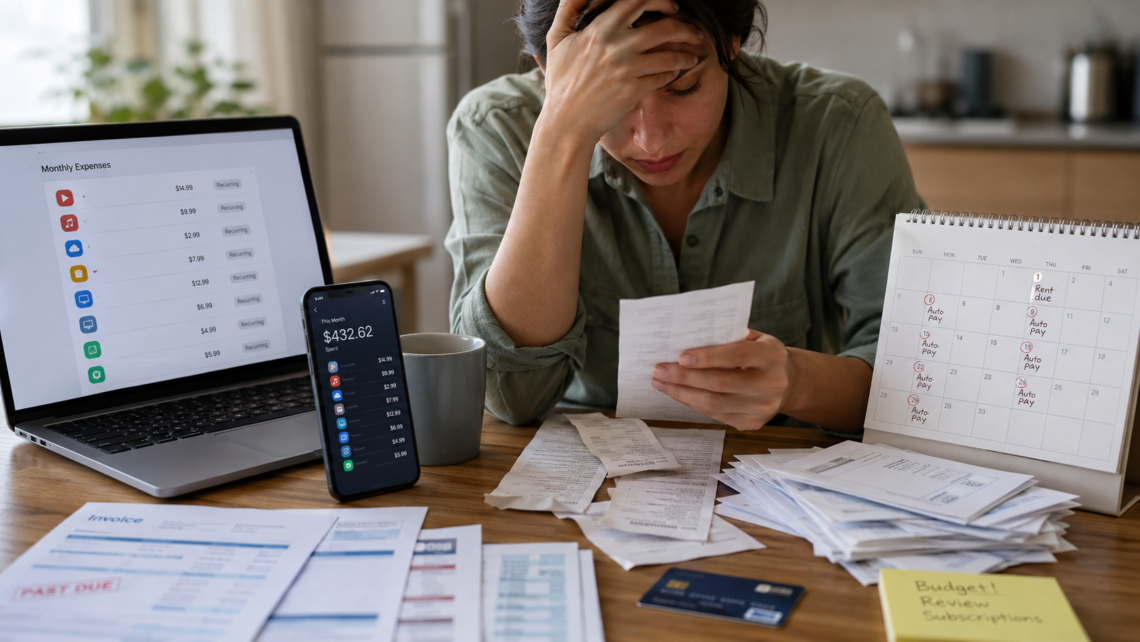
Why Everything Is Becoming a Subscription and When You Should Just Say No
Monthly payments are replacing one-time purchases everywhere. Sometimes that makes sense. Increasingly, it doesn’t.
Lifehappens2us.com | August 26, 2026
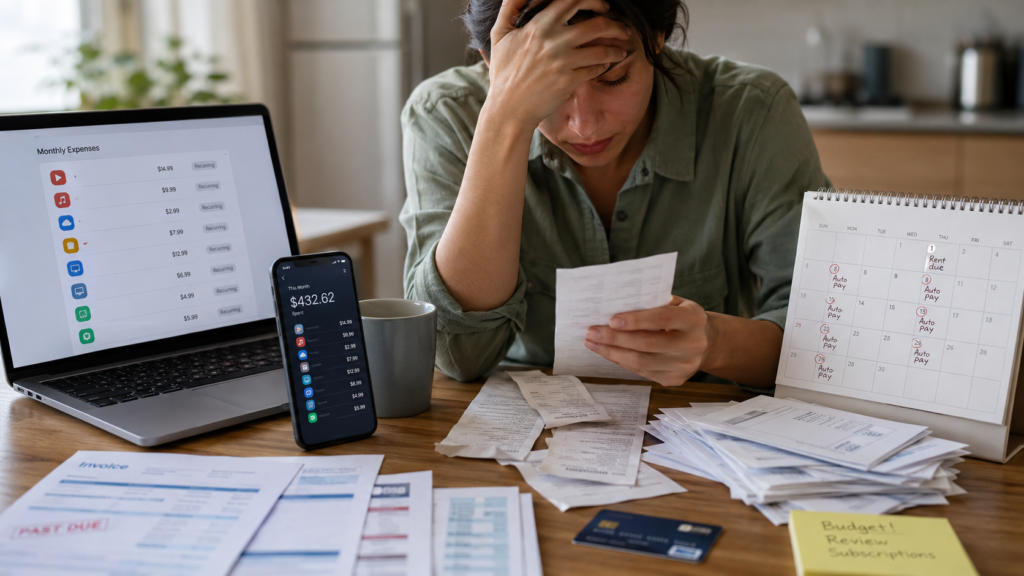
Recurring charges can be easy to ignore until they accumulate into a major monthly expense.
There was a time when buying something meant you owned it.
You bought a television, a piece of software, a car accessory, a security camera, or even a video game, and that was more or less the end of the transaction. The company made its money, you got your product, and everyone moved on.
That model is disappearing.
Today, businesses increasingly want us to keep paying long after the original purchase. Software requires monthly subscriptions. Security cameras charge to store recordings. Cars may offer features that remain locked unless you continue paying. Fitness apps, cloud storage, streaming services, delivery memberships, productivity tools, and even relatively simple consumer products increasingly come with recurring fees.
Individually, many of these charges seem small.
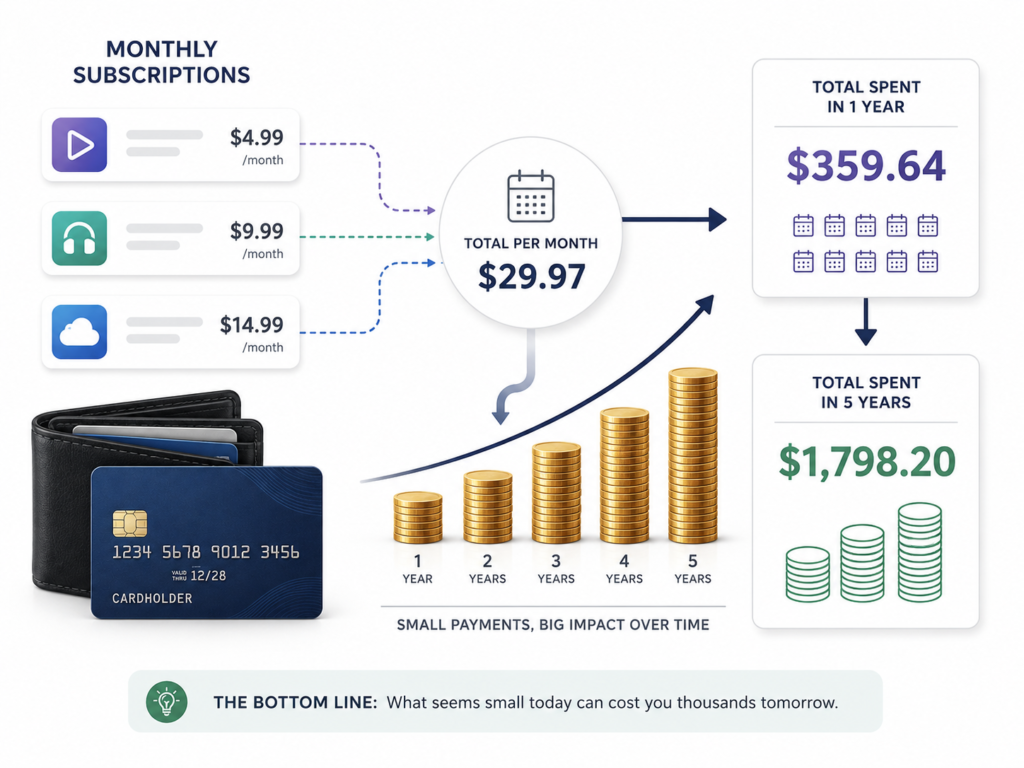
$4.99 here. $9.99 there. Another $14.99 somewhere else.
The problem is that they add up, and unlike a traditional purchase, they never really end.
Why Companies Love Subscriptions
From a business perspective, the subscription model is easy to understand.
If a company sells you a $100 product once, it earns $100.
If it can instead convince you to pay $10 every month, that same customer may generate $120 in the first year, $240 after two years, and $600 after five.
Even better for the company, subscription revenue is predictable.
Executives and investors love predictable revenue because they can estimate how much money is likely to arrive next month or next year. A company with millions of customers making recurring payments has a much more reliable income stream than one that must continually convince customers to make new purchases.
There is nothing inherently wrong with that.
A subscription can be perfectly reasonable when a company is providing an ongoing service.
Netflix continuously licenses and produces new entertainment. Cloud storage providers maintain servers and infrastructure. Internet providers operate networks. News organizations continuously employ reporters and editors.
Those are ongoing services with ongoing expenses.
The problem starts when companies apply the subscription model to products or features that historically would have been included in the original purchase.
The Difference Between a Service and a Toll Booth
Consumers should start asking a simple question:
“Am I paying for an ongoing service, or am I paying a toll to continue using something I already bought?”
That distinction matters.
If a home security camera company stores video footage on its servers, maintaining those servers costs money. Charging for cloud storage is understandable.
But suppose the camera contains a feature that is entirely processed inside the device you purchased, yet the manufacturer disables that feature unless you continue paying a monthly fee.
That feels very different.
The hardware is already sitting in your house.
You paid for it.
The manufacturer isn’t necessarily providing a meaningful additional service every month. It may simply be controlling access to functionality that already exists inside the product.
That is where subscription models can begin to feel less like services and more like digital toll booths.
The $10 Problem
One reason subscription spending gets out of control is that companies deliberately keep individual payments small enough that customers don’t think much about them.
Most people would carefully consider a $600 purchase.
But $9.99 per month doesn’t feel like $600.
Yet if you keep that subscription for five years, that is essentially what you paid.
The psychology of monthly payments changes how we perceive cost.
Consider three services:
- $9.99 per month
- $14.99 per month
- $19.99 per month
Together, they cost about $45 per month.
That doesn’t sound particularly alarming.
But over a year, that becomes roughly $540.
Over five years, assuming prices never increase, you’re approaching $2,700.
And that might represent only three subscriptions.
Many households have far more.
Streaming services, cloud storage, antivirus software, fitness apps, gaming memberships, delivery services, music subscriptions, smart-home services, AI tools, photo storage, productivity apps, and various forgotten free trials can quietly turn into hundreds of dollars in recurring monthly expenses.
The Forgotten Subscription May Be the Most Profitable Subscription
Companies also benefit from something consumers rarely think about: inertia.
People don’t always cancel things they no longer use.
Maybe you signed up for a streaming service to watch one show.
Maybe you subscribed to an app for a project six months ago.
Maybe you joined a premium membership because it included a free trial.
Eventually, you stop using it.
But the charge stays on the credit card.
Five dollars here and twelve dollars there disappear among groceries, gasoline, restaurants, utilities, and dozens of other transactions.
That forgotten subscription may continue for months or even years.
For the business collecting that money, a customer who forgets to cancel can be extremely valuable.
When a Subscription Actually Makes Sense
Not every subscription is bad.
In some cases, subscriptions are better for consumers.
They can make expensive software accessible without requiring a large upfront purchase. They can pay for regular updates, cybersecurity protection, customer support, server infrastructure, new content, or cloud services.
A subscription generally makes sense when you receive continuous value that requires continuous work or resources from the company.
Good examples might include:
streaming entertainment that regularly adds new content;
cloud backup and storage;
internet and cellular service;
regularly updated professional software;
monitoring services;
news and research publications;
services involving ongoing human support.
In these situations, you aren’t simply paying for the same product repeatedly. You’re paying for something that continues to operate, evolve, or provide new value.
When You Should Be Suspicious
There are several warning signs that a subscription may not be worth keeping.
Be cautious when the recurring fee mainly unlocks hardware you already purchased.
Be cautious when you cannot clearly explain what new value you’re receiving each month.
Be cautious when canceling is much harder than subscribing.
And be especially cautious when the service starts inexpensive but gradually increases in price while adding very little additional value.
One useful question is:
“If I had to pay for an entire year upfront today, would I still subscribe?”
A $12.99 monthly payment sounds small.
A $155.88 annual purchase forces you to think differently.
If you wouldn’t willingly pay the annual amount, you may not really value the subscription as much as you think.
Perform a Subscription Audit
At least once or twice a year, look through your bank and credit-card statements specifically for recurring payments.
Don’t just look for large charges.
Look for the small ones.
Write down every service that automatically charges you.
Then ask three questions:
- Do I still use it?
- Would I sign up for it again today?
- Is there a cheaper one-time purchase or alternative?
If the answer to the first two questions is no, cancel it.
The amount doesn’t matter.
A $6 subscription that provides no value is still wasted money.
Ownership Still Has Value
The larger issue goes beyond saving a few dollars.
We are gradually moving from an economy in which consumers own products toward one in which consumers continuously rent access to them.
That may be convenient in some cases.
But ownership has advantages.
A product you own outright doesn’t disappear because your credit card expired. Its price doesn’t suddenly increase next month. You don’t lose access because a company changes its business model. You don’t have to wonder whether a service will shut down.
Sometimes the old-fashioned approach of buying something once and keeping it is still the better deal.
Companies have learned that recurring revenue is extremely valuable.
Consumers should learn the same lesson from the opposite direction:
Recurring expenses are extremely expensive.
Before adding another monthly payment to your life, ask whether you’re really receiving an ongoing service — or simply being asked to pay forever for something that once would have been yours.

Hector
Just a guy with a lot of thoughts on a lot different things. This site is where I can share some of those thoughts. I'm in Defense and Aerospace and we will leave it at that.


You May Also Like

EPCOT Food & Wine Festival 2026: Dates, Food, Concerts & Local Tips

Disney Springs Orlando Guide 2026: Free Things to Do, Food & Family Fun