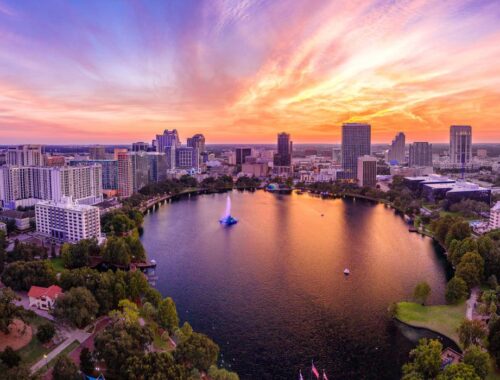
Church Street Renovation & The Canopy: Downtown Orlando’s Big Transformation
Church Street Is Being Rebuilt — and Orlando’s New Park Under I-4 Could Transform This Side of Downtown
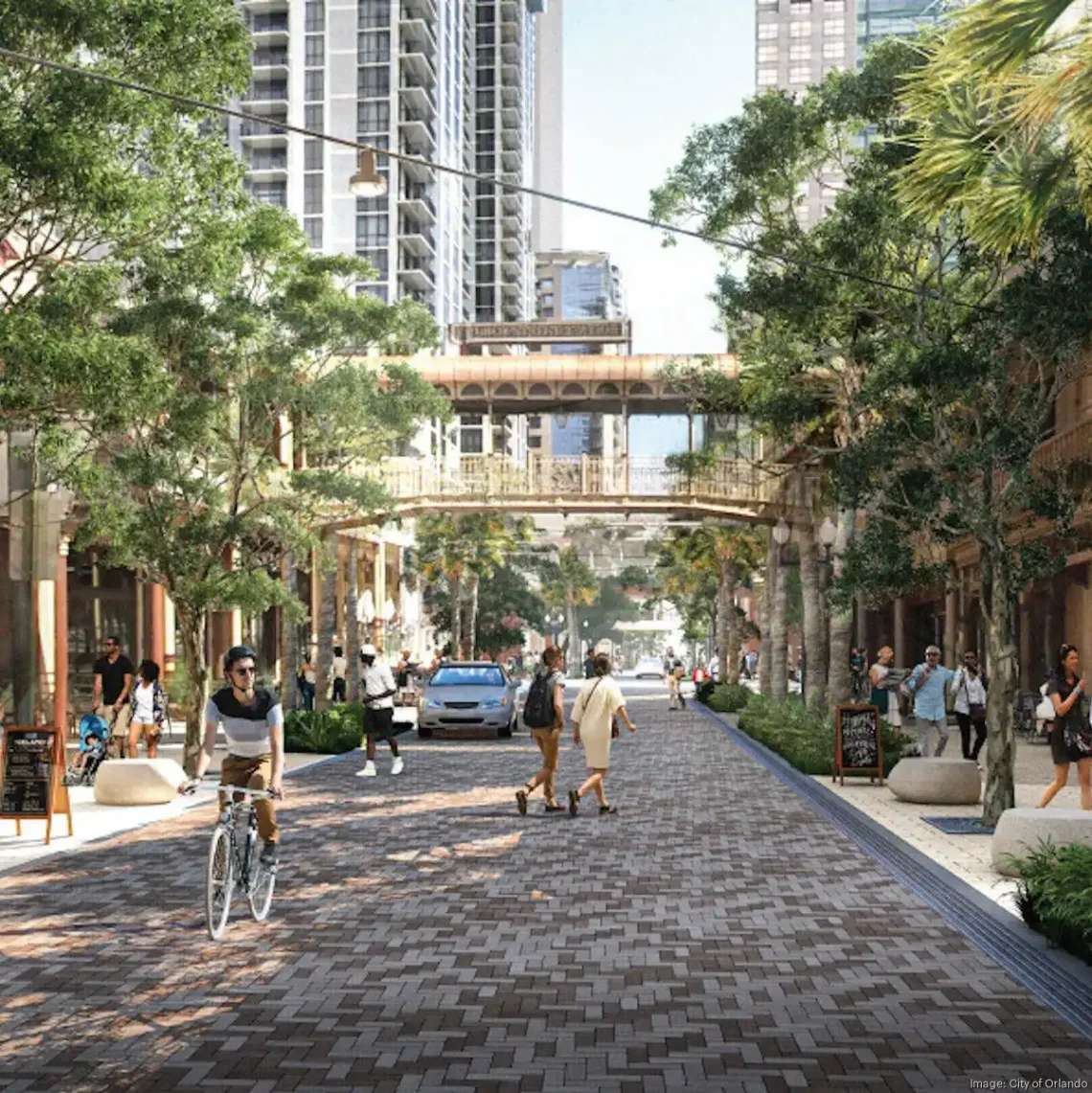
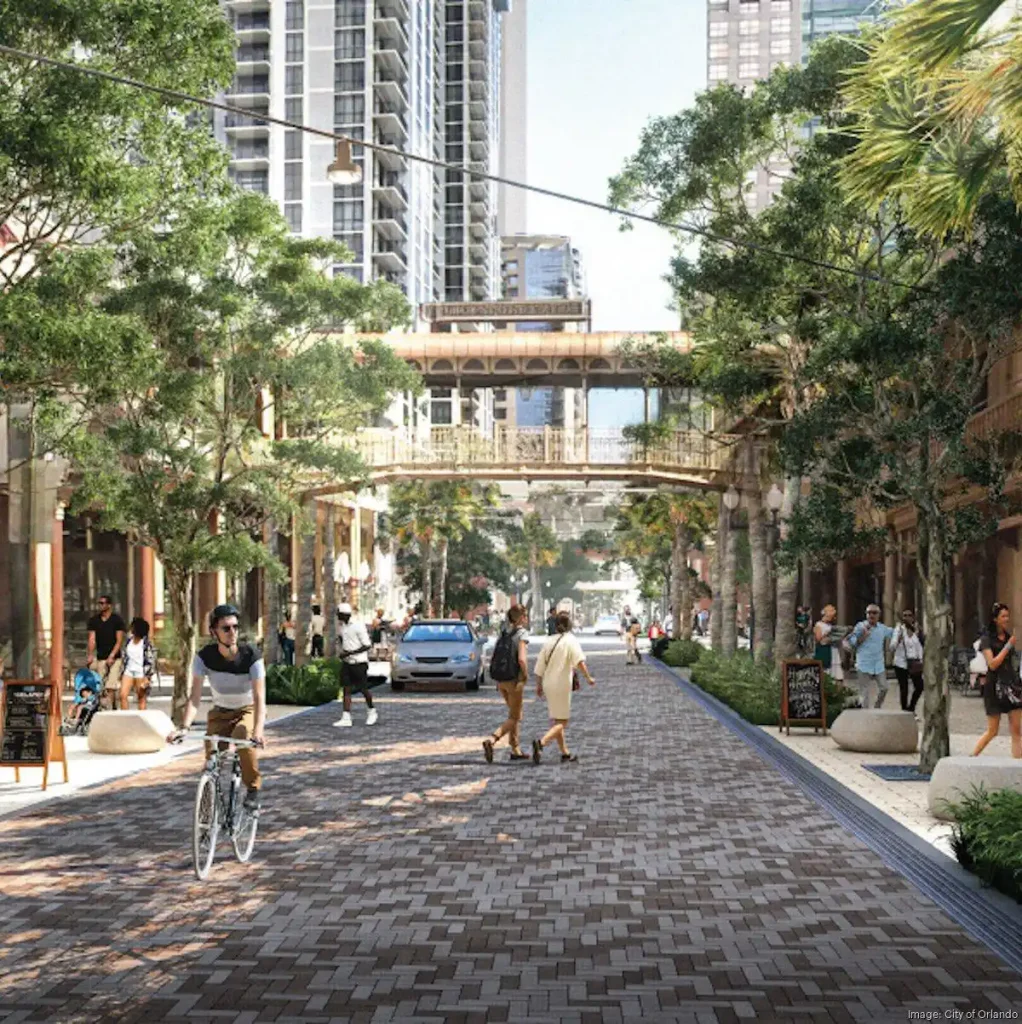
Construction is already underway on Church Street’s conversion into a pedestrian-focused “festival street.” Just a few steps away, Orlando is preparing to turn roughly 10 acres beneath I-4 into The Canopy, a new public space with trails, events, art, parking and places to gather. Together, the two projects could significantly change how people experience downtown Orlando.
For a long time, downtown Orlando has had an unusual problem.
Some of its biggest destinations are remarkably close together.
The Kia Center.
Church Street Station.
SunRail.
Downtown restaurants and bars.
City Hall.
Dr. Phillips Center.
Inter&Co Stadium farther west.
Yet moving between those places on foot doesn’t always feel as easy or inviting as the map suggests.
Interstate 4 creates a particularly obvious barrier.
Then there’s Church Street itself, one of downtown Orlando’s most historic corridors, which has spent years functioning more like a street people pass through than a place they stay.
Orlando is now trying to change both of those things at the same time.
Construction has begun on a major redesign of Church Street, while another project called The Canopy is preparing to transform the large area underneath I-4 into a new downtown public space. (City of Orlando)
Taken together, the projects could create something downtown has been missing:
A more continuous public corridor connecting entertainment, transit, restaurants, events and neighborhoods on both sides of I-4.
Church Street Construction Has Already Started
This part isn’t just a rendering anymore.
The City of Orlando officially broke ground on the Church Street Festival Street project on July 7, 2026. (City of Orlando)
The full project will eventually rebuild Church Street from Garland Avenue east to Magnolia Avenue.
Instead of treating Church primarily as a vehicle corridor, Orlando intends to make it a flexible street that can function normally when needed but also become a pedestrian-oriented public space for festivals, outdoor dining and community events. (City of Orlando)
That’s an important distinction.
The street isn’t simply being resurfaced.
It’s being redesigned around how people actually use downtown.
Phase 1 Is Happening Near I-4
The first construction phase runs from Garland Avenue to the railroad tracks near Church Street Station.
The city currently lists the Phase 1 budget at $5.2 million. (City of Orlando)
The redesign includes:
Two 11-foot travel lanes
A curbless roadway
A nearly seamless transition between the driving and pedestrian areas
Semi-pervious paving
Dedicated loading and unloading areas
Additional landscaping space
and a street surface designed to support both ordinary traffic and special events. (City of Orlando)
In other words, when there isn’t an event, cars can still use the street.
When there is an event, the space can function much more like a plaza.
Why Remove the Curbs?
That may sound like a tiny design detail.
It isn’t.
A traditional street has clearly separated levels:
Sidewalk.
Curb.
Roadway.
A festival street can bring those surfaces closer to the same level.
That makes it easier to temporarily reclaim much more of the street for pedestrians.
Close the road for an event and suddenly you don’t have people standing on narrow sidewalks beside a large empty roadway.
The entire space becomes usable.
Tables can move out.
People can walk across the street naturally.
Small performances, markets and community events can spread through the corridor.
That’s the basic idea Orlando is pursuing on Church Street.
Church Street Isn’t Becoming a Permanent Pedestrian Mall
This is worth clarifying.
Cars are not being permanently eliminated from Church Street.
The city describes it as a flexible-use corridor that balances vehicles, deliveries, transit and pedestrians. (City of Orlando)
The objective is to discourage unnecessary cut-through traffic while still allowing people to reach businesses, hotels, parking and other destinations.
That’s probably a more realistic approach for downtown Orlando than permanently closing the entire corridor.
Phase 1 Should Be Finished in Early 2027
Orlando’s current project page lists Phase 1 construction beginning in July 2026 with completion expected in the first quarter of 2027, following an estimated eight-to-ten-month construction period. (City of Orlando)
The city is completing the work block by block.
That means portions of Church Street will be closed curb-to-curb while construction takes place.
But there’s an important message for people heading downtown:
The businesses are still open.
The city says sidewalks will generally remain available throughout construction, although pedestrians may encounter short detours around intersections. (City of Orlando)
So don’t assume a barricade means the restaurant or business behind it is closed.
Expect Some Inconvenience for a While
There’s no realistic way to rebuild a downtown street without causing disruption.
The city currently warns of:
Road closures.
Temporary intersection closures.
Traffic delays.
Occasional driveway restrictions.
Construction equipment.
And periodic night or weekend work. (City of Orlando)
Normal work hours are generally Monday through Friday from 7 a.m. until 5 p.m. (City of Orlando)
If you’re going to an event at Kia Center or somewhere around Church Street, allow extra time.
This is one of those situations where short-term inconvenience is part of getting to the finished project.
Church Street’s Transformation Doesn’t End at the Railroad Tracks
Phase 1 is only the beginning.
Orlando has divided the larger Church Street project into three phases.
Phase 2: Railroad Tracks to Orange Avenue
The second section will continue the festival-street concept east toward Orange Avenue.
Plans call for textured paving designed to visually extend the pedestrian environment into the street, along with:
Benches.
Planters.
Movable furniture.
Loading areas.
And places where people can sit and gather.
The city currently anticipates completing this portion in spring 2028. (City of Orlando)
Phase 3: Orange Avenue to Magnolia Avenue
The final phase goes farther east to Magnolia.
One of the biggest changes here will be converting Church Street from one-way eastbound traffic to two-way traffic.
LYMMO buses are also planned to operate within the normal travel lanes rather than using a separate configuration.
Current completion target:
Early summer 2028. (City of Orlando)
So this is not a six-month beautification project.
Orlando is rebuilding a substantial portion of the corridor over several years.
Then There’s What Is Happening Under I-4
This may ultimately be the more dramatic project.
For decades, the land underneath an elevated interstate was exactly what you’d expect.
Concrete.
Columns.
Traffic overhead.
Parking.
Fenced-off areas.
Not somewhere anyone particularly wanted to spend time.
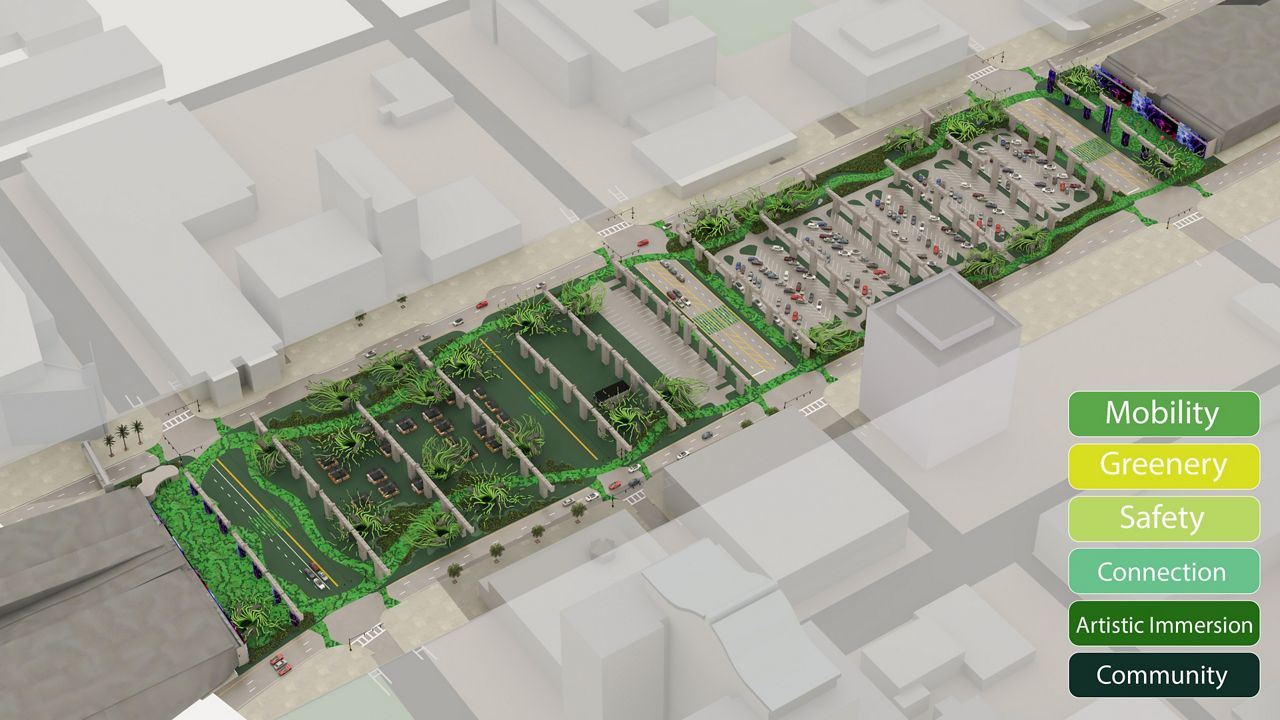
Orlando plans to turn approximately 10 acres underneath I-4 into a public destination called The Canopy. (City of Orlando)
The project stretches from around Church Street north toward Washington Street, between Garland Avenue and Hughey Avenue. (City of Orlando)
And the latest timeline is finally getting close.
The Canopy Is Expected to Start Construction This Fall
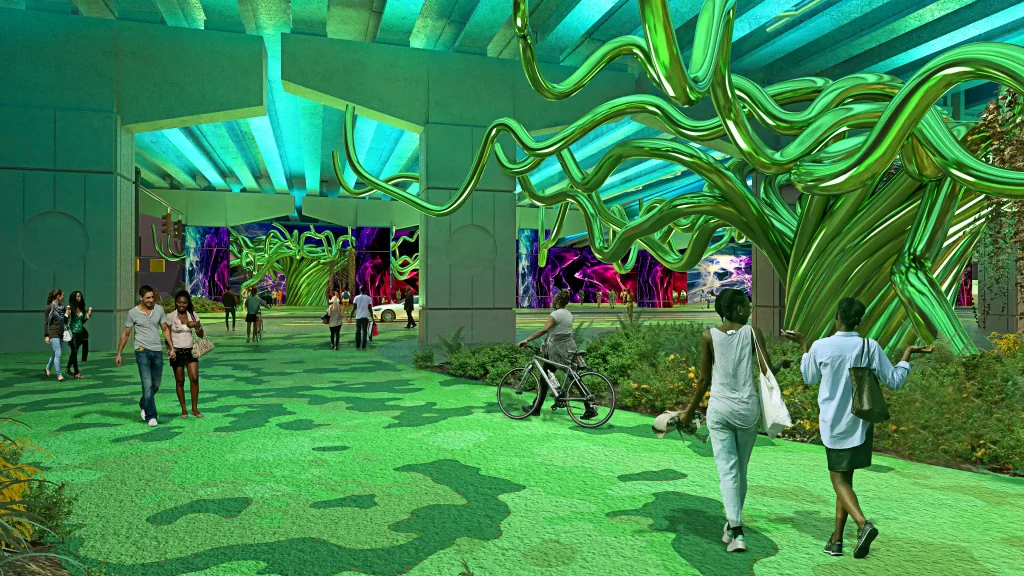
The city currently lists an anticipated third-quarter/fall 2026 construction start, with completion expected in the fourth quarter of 2027. (City of Orlando)
In August, Orlando received the final local approvals needed to move the project toward construction.
At that time, officials said work could begin within approximately 60 days. (Bay News 9)
So as of late September, this isn’t some distant 2035 vision.
Construction is expected to begin soon.
This Isn’t Just Going to Be a Park With Grass
The word “park” doesn’t completely describe what Orlando is building.
The Canopy is being designed as a combination of:
Public park.
Event space.
Walking and bicycle connection.
Public-art installation.
Mobility hub.
Parking area.
Rideshare zone.
And gathering space. (City of Orlando)
The city identified six guiding ideas for the project:
Connection
Safety
Community
Greenery
Mobility
and
Artistic immersion. (City of Orlando)
The objective is essentially to turn the underside of the highway from a barrier into a connector.
There Will Be Nearly 300 Parking Spaces
Here’s one feature downtown visitors will probably appreciate immediately.
Current plans include nearly 300 parking spaces, primarily toward the northern portion of the project. (Bay News 9)
That’s important because converting underused interstate land into public space could have eliminated parking altogether.
Instead, the plan tries to combine parking with public use.
There will also be designated areas for rideshare pickups and drop-offs. (Bay News 9)
For Kia Center events, soccer matches, nightlife and downtown festivals, having an organized rideshare location could be particularly useful.
Bikes and Scooters Get Their Own Hub
The Canopy will also include a hub for e-bikes and e-scooters, plus pedestrian and bicycle corridors running through the site. (Bay News 9)
City officials describe two major pedestrian/bicycle connections, one toward the eastern side and another toward the west.
That matters because I-4 has long acted as a psychological as well as physical dividing line downtown.
Making it easier and more pleasant to walk or bike underneath the highway could help connect destinations on either side.
And Yes, There Will Be Public Restrooms
This may be one of the least glamorous details in the entire project.
It’s also one of the most useful.
The Canopy plans include public restrooms. (Bay News 9)
Downtown public spaces become considerably more practical for families, festivals and longer visits when basic facilities are available.
This is exactly the kind of detail that determines whether a park is somewhere people actually spend two hours or somewhere they walk through in ten minutes.
The Giant Metal Trees Are Real
If you’ve seen the renderings, you’ve probably noticed some strange-looking structures.
Those aren’t decorative placeholders.
The project is being designed around large metal tree-like sculptures and digital elements intended to mimic the feeling of a canopy where real mature trees can’t easily grow beneath an interstate. (Orlando Shine)
The structures will become part of the central event space.
It’s an interesting solution to an obvious problem.
You can’t plant a conventional urban forest directly beneath elevated highway lanes.
So designers are using landscaping where possible and combining it with sculptural artificial “trees” to create visual identity and shade-like architectural elements.
The Entire Space Can Become Digital Art
This is probably the project’s most unusual feature.
The Canopy is designed to incorporate extensive programmable lighting and digital projection.
City officials have described the central area as being digitally mapped so colors, graphics, sound and imagery can be changed for different events and occasions. (CF Public)
That means the space could look completely different depending on what’s happening.
A holiday event.
An Orlando City match.
A concert.
A festival.
A cultural celebration.
Or simply a different nighttime art program.
Instead of installing one permanent mural and leaving it unchanged for 20 years, the digital layer gives the space the ability to continually evolve.
The Canopy Will Cost More Than $30 Million
The City of Orlando lists The Canopy with a $30 million city project budget. (City of Orlando)
The Florida Department of Transportation is also contributing $3.75 million, putting currently identified funding at roughly $33.75 million. (Bay News 9)
That’s a substantial investment for downtown public space.
The useful question for residents will ultimately be whether the space becomes heavily used.
If it turns into somewhere people regularly walk, meet, attend events, park and pass through between downtown districts, the value will look very different than if it becomes mostly decorative.
The design is clearly aimed at the former.
Church Street and The Canopy Are Really One Larger Story
This is the part that makes these two projects more interesting together than separately.
Look at the geography.
Church Street runs directly through the area.
The Canopy occupies the space under I-4.
Church Street Station and SunRail are immediately east.
Kia Center is nearby.
Downtown nightlife sits to the east.
Inter&Co Stadium and Parramore are to the west.
For years, those destinations have existed relatively close together without feeling like one continuous pedestrian district.
Church Street and The Canopy could help stitch them together.
Instead of walking underneath I-4 feeling like you’re crossing leftover highway infrastructure, you’d potentially walk through an actual public place.
Then you emerge onto a Church Street designed to encourage people to stay rather than simply move through.
That’s the larger idea.
Think About a Kia Center Night in 2028
Imagine going downtown once both projects are finished.
Park under or near The Canopy.
Walk through digital art installations.
Meet friends in the public space.
Walk down the redesigned Church Street.
Have dinner outside.
Continue to Kia Center for a game or concert.
Afterward, return through the same public corridor.
That’s a substantially different experience from driving directly into a garage, attending the event and leaving.
And that difference matters if Orlando wants downtown to become a destination rather than simply a collection of individual venues.
Families Could Benefit Too
Downtown Orlando is often perceived as primarily nightlife-oriented.
The DTO Action Plan is trying to broaden that.
Church Street is being designed for festivals, community events and outdoor activity, while The Canopy emphasizes public gathering areas and pedestrian space. (City of Orlando)
That creates opportunities for:
Markets.
Art events.
Holiday celebrations.
Family festivals.
Food events.
Performances.
Public screenings.
And community gatherings.
Exactly what programming eventually fills the space will matter enormously.
Infrastructure alone doesn’t create activity.
People and events do.
But at least Orlando is building a place where those things can happen.
This Is Also About Fixing a Problem I-4 Created
There’s an interesting historical connection here.
Highways made it easier to drive into downtown.
They also divided neighborhoods and created large pieces of unusable or unpleasant land underneath them.
The Canopy represents a modern attempt to reclaim some of that space.
Orlando isn’t removing I-4.
It’s asking a more practical question:
If the highway has to be there, can the land underneath it become useful?
Other cities have been asking the same question.
Turning infrastructure leftovers into parks and public spaces has become an increasingly common form of urban redevelopment.
Orlando now gets its own version.
The Construction Period Will Be Messy
There’s no reason to sugarcoat this.
Church Street is already under construction.
The Canopy is about to add another major construction project nearby.
Other downtown transportation and streetscape projects are also advancing.
For a while, that means:
Barricades.
Detours.
Construction noise.
Changed traffic patterns.
And the occasional feeling that downtown Orlando is rebuilding everything at once.
If you work downtown or frequently attend events there, expect some frustration.
But this is also the period when years of renderings finally begin turning into physical changes.
Don’t Write Off Church Street While Construction Is Happening
This is particularly important for local businesses.
Street construction can make people unconsciously assume an entire area is inaccessible.
It isn’t.
Orlando specifically says sidewalks will remain open during the current Church Street work, with only occasional short pedestrian detours. (City of Orlando)
Restaurants and businesses along the corridor still need customers while the street is being rebuilt.
If you’re heading downtown anyway, don’t let the orange fencing automatically send you somewhere else.
When Will Everything Be Finished?
Here are the current official timelines.
Church Street Phase 1
Garland Avenue to railroad tracks
Construction underway
Expected completion: First quarter 2027. (City of Orlando)
The Canopy
Church Street to Washington Street beneath I-4
Expected start: Fall 2026
Expected completion: Fourth quarter 2027. (City of Orlando)
Church Street Phase 2
Railroad tracks to Orange Avenue
Expected completion: Spring 2028. (City of Orlando)
Church Street Phase 3
Orange Avenue to Magnolia Avenue
Expected completion: Early summer 2028. (City of Orlando)
As always with construction, schedules can move.
But for the first time, large parts of this downtown vision are either actively under construction or approaching it.
This Could Be One of Downtown Orlando’s Most Important Changes
Orlando isn’t lacking big attractions.
What downtown has sometimes lacked are the smaller connections between them.
The walk.
The shade.
The place to sit.
The public restroom.
The space for a festival.
The safe route underneath the highway.
The street where people feel comfortable stopping rather than rushing through.
Those aren’t spectacular individually.
Together, they determine whether downtown feels like a collection of buildings or an actual neighborhood.
That’s why Church Street and The Canopy are projects worth watching.
One rebuilds one of Orlando’s most recognizable streets.
The other turns land beneath one of its biggest pieces of infrastructure into something people can actually use.
And where the two meet may eventually become one of the most interesting public spaces in downtown Orlando.

Hector
Just a guy with a lot of thoughts on a lot different things. This site is where I can share some of those thoughts. I'm in Defense and Aerospace and we will leave it at that.

You May Also Like
Orlando Farmers Markets 2026: Best Markets by Day & Location

Things to Do in Orlando This Weekend: Sept. 25–27, 2026