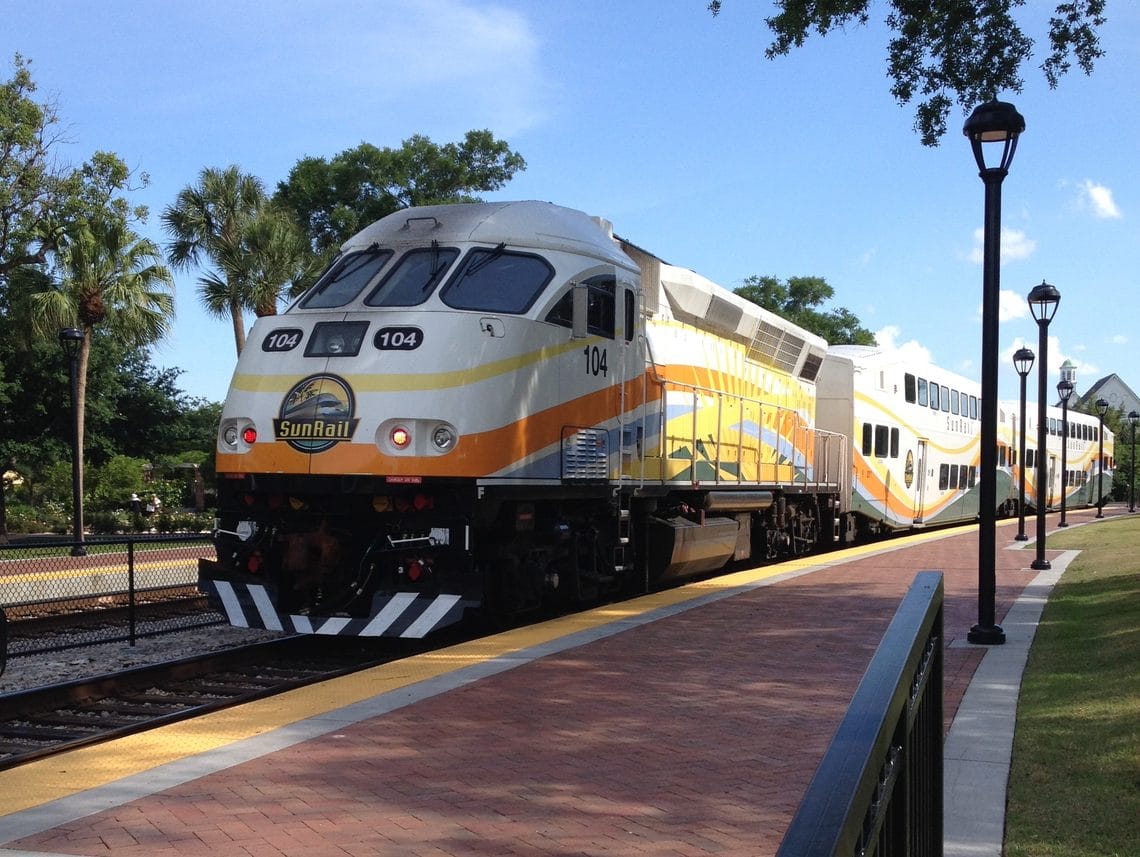
Orange County Plans Bigger SunRail and LYNX System for Orlando
Orange County Has a Bigger Plan for SunRail and LYNX — Here’s What It Could Mean for Getting Around Orlando
More frequent buses, weekend and evening SunRail service, an eventual rail connection to Orlando International Airport and the attractions district, new mobility hubs and better connections between transit systems could gradually change how Greater Orlando residents get around.
If you live in Greater Orlando, you’ve probably had this experience.
You look at the traffic on I-4.
Then you look at your navigation app.
And somehow every alternate route is red too.
Central Florida has spent decades growing around the automobile. That isn’t going to disappear anytime soon.
But Orange County is increasingly pursuing another strategy:
Give people more alternatives to driving everywhere.
The county’s long-term transportation vision includes expanded LYNX bus service, more frequent buses, improved bus stops, longer SunRail operating hours, weekend trains, more frequent rail service and eventually a major SunRail expansion connecting Orlando International Airport with the Orange County Convention Center and the International Drive tourism district.
Some of those improvements are already being funded.
Others are still years away.
And some will depend on finding substantial amounts of local, state and federal money.
But taken together, they show where Orange County wants Greater Orlando’s transportation system to go.
The First Big Change Could Be Making SunRail Useful More Often
SunRail has always had one major problem.
It works fairly well if your life fits its schedule.
If it doesn’t, the train becomes much less useful.
SunRail remains primarily a weekday commuter service. That means residents generally cannot depend on it for a Saturday trip into downtown Orlando, a Sunday afternoon in Winter Park or many late-night activities.
Orange County’s transportation planning documents envision changing that.
The county has identified new evening and weekend SunRail service as a goal expected by 2027, while longer-term plans envision additional increases in train frequency.
The planning vision calls for trains eventually operating approximately:
Every 15 minutes during peak periods
Every 30 minutes during off-peak periods
Every 60 minutes on weekends
The increased frequency on the existing north-south SunRail corridor is identified as a longer-term improvement expected around 2031.
Those changes could be more important than they initially sound.
Weekend SunRail Could Change How Locals Use the Train
Right now, many Central Florida residents think of SunRail primarily as a commuter train.
Weekend service could change that perception.
Imagine living near Maitland and taking the train into downtown Orlando for an event without worrying about parking.
Or traveling from Kissimmee to Winter Park for lunch.
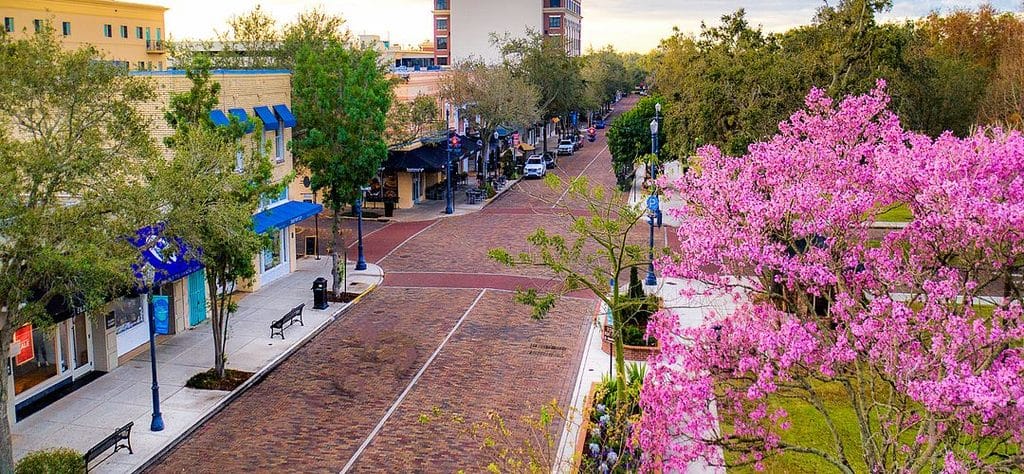
Or taking SunRail to Church Street for a concert or sporting event.
Or riding into Orlando and transferring to LYMMO or another LYNX route.
That starts turning SunRail from something designed primarily around the Monday-through-Friday commute into a regional transportation option.
It also makes the existing infrastructure more useful.
Orange County and the region have already invested heavily in stations, tracks, trains and associated infrastructure.
Running those trains during more of the week allows residents to get more use out of infrastructure that already exists.
Then Comes the Much Bigger Idea: SunRail to the Airport
This is where Central Florida’s transportation plans become considerably more ambitious.
The proposed Sunshine Corridor would expand passenger rail service from the existing SunRail system to Orlando International Airport.
From there, the proposed corridor would continue west toward the Orange County Convention Center, South International Drive and the Disney Springs area.
The Florida Department of Transportation describes the Sunshine Corridor as a multi-phase passenger-rail program intended to connect major employment centers and improve regional mobility.
It would also create a direct connection between SunRail and Brightline at Orlando International Airport.
That could eventually produce something Greater Orlando has never really had:
A connected regional rail network.
Imagine What That Network Could Look Like
Consider the possibilities if the entire concept is eventually completed.
A resident in Winter Park could board SunRail and reach Orlando International Airport.
Someone living in Kissimmee could potentially use rail to reach the International Drive area.
A visitor arriving on Brightline from South Florida could transfer at the airport and continue toward the Convention Center or attractions district.
An airport employee could potentially commute by rail.
Convention workers could have another option besides driving.
Tourism employees living elsewhere along the SunRail corridor could potentially reach jobs around International Drive without making the entire trip by automobile.
That’s fundamentally different from today’s system.
Today we have several transportation services that sometimes connect.
The longer-term objective is to make them operate more like parts of one network.
Don’t Expect the Sunshine Corridor Tomorrow
This is an important reality check.
The Sunshine Corridor is not under construction.
It remains a major transportation planning project.
FDOT’s current project information lists the corridor in the planning phase, and the agency updated the project information as recently as July 20, 2026.
Orange County planning materials have identified approximately 2035 as a possible timeframe for new SunRail service to Orlando International Airport and the Sunshine Corridor.
That’s almost a decade away.
Large rail projects require environmental studies, engineering, property agreements, federal approvals and, most importantly, funding.
So residents should think of the Sunshine Corridor as the direction Central Florida is trying to move—not a train you’re going to board next year.
LYNX May Actually Be the More Important Part of the Plan
Rail gets the headlines.
Buses do most of the work.
LYNX already connects SunRail stations throughout Central Florida with dozens of bus routes.
At LYNX Central Station in downtown Orlando, passengers can connect between SunRail and 29 LYNX routes. Other stations have connections ranging from conventional buses to NeighborLink and on-demand services.
Orange County has therefore been putting money into making the bus system more useful.
Through its Accelerated Transportation Safety Program, the county identified $45 million over five years for LYNX improvements, primarily to increase bus frequency and add shelters.
That’s important because frequency may be the single biggest factor determining whether a bus is practical.
Nobody Wants to Plan Their Life Around a Bus That Comes Once an Hour
Suppose you walk out of work at 5:10 p.m.
If the next bus arrives at 5:20, public transportation feels practical.
If the next bus arrives at 6:05, driving becomes much more attractive.
Orange County’s plan specifically calls for increasing service frequency along major corridors throughout the county.
Some of those improvements have already happened.
Orange County reported this summer that its Accelerated Transportation Safety Program had increased LYNX operating frequency while also helping install 52 new bus shelters.
The county’s FY2025-26 budget also provides approximately $101.9 million toward LYNX service, an increase of about 14.5 percent from the prior year’s budget.
So unlike some of the longer-term rail ideas, increased investment in LYNX isn’t merely conceptual.
Money is already being spent.
Orange County Wants Better Bus Stops Too
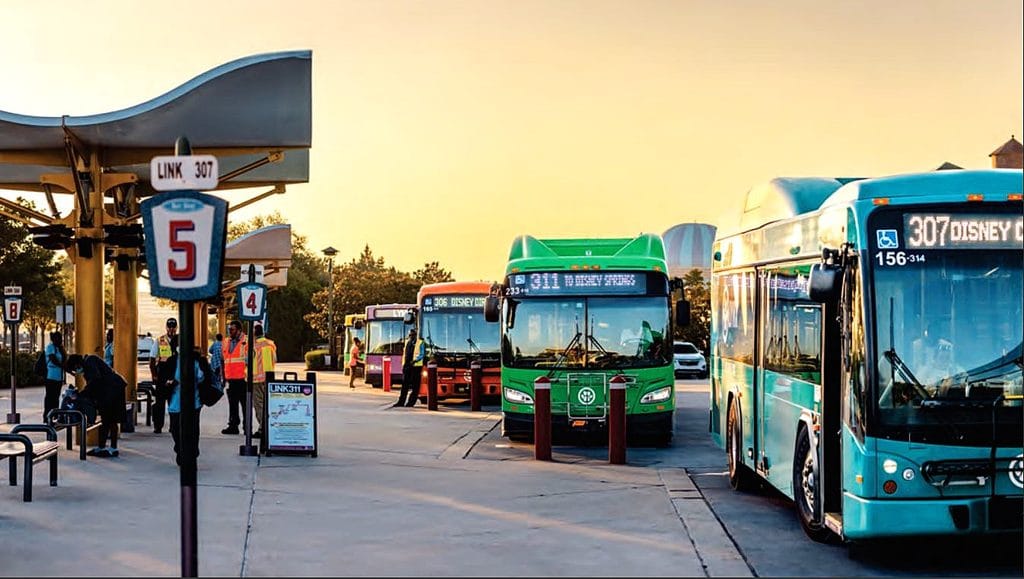
Anyone who has waited for a bus in Orlando in August understands why this matters.
A pole beside the road is technically a bus stop.
It isn’t necessarily a pleasant place to wait for a bus.
Orange County’s transportation program calls for LYNX to add 44 new sheltered bus stops in each county commission district.
The planned shelters can include seating, overhead protection, solar lighting, maps and passenger information, bicycle parking, fare equipment and ADA-accessible features.
Shade isn’t a luxury in Central Florida.
Neither is protection from one of our afternoon thunderstorms.
If Orange County wants more people to use public transportation, the experience between leaving your house and actually boarding the bus matters almost as much as the bus itself.
New Mobility Hubs Could Help Connect Everything
Another less glamorous but potentially important piece is something called a mobility hub.
The basic idea is simple.
Instead of treating buses, bicycles, pedestrians, rideshare and other transportation options as completely separate systems, create locations where people can conveniently switch between them.
Orange County received a $271,000 federal grant this year to develop mobility hubs in partnership with LYNX and Orange County Public Schools.
The initial locations involve the new Pine Hills Transfer Center and Orange Technical College’s South Campus.
The concept emphasizes safe access for people arriving by bus, bicycle or on foot.
That may sound like a small project.
But connections are where public transportation often succeeds or fails.
Pine Hills Already Has a New Kind of Transit Hub
The Pine Hills Transfer Station is a good example of the direction LYNX is heading.
Instead of forcing many west Orange County passengers to travel all the way downtown simply to change buses, the Pine Hills facility gives riders another major transfer point.
Orange County contributed more than $1 million toward the station and related improvements to Belco Drive through agreements with LYNX.
Facilities like this may not receive the attention of a new train station, but decentralizing the bus network can make cross-county trips considerably more practical.
International Drive Could Get Its Own Higher-Quality Transit System
There’s another transportation project worth watching.
Orange County has begun the next phase of its International Drive Transit Feasibility and Alternative Technology Assessment.
The study is examining improved transit along International Drive from Sea Harbor Drive to Sand Lake Road, including portions of Destination Parkway and Sea Harbor Drive.
Orange County and LYNX are preparing the project so it can potentially compete for funding through the Federal Transit Administration’s Capital Investment Grant Small Starts Program.
Exactly what the final system will look like remains to be determined.
But the objective is important.
International Drive is one of the largest concentrations of hotels, restaurants, attractions, convention activity and tourism employment in Florida.
Moving more people through that corridor without requiring every person to occupy a separate automobile could have benefits well beyond tourists.
Thousands of Central Florida residents work there every day.
The Real Goal Should Be Connecting SunRail and LYNX
This may ultimately be more important than expanding either system individually.
A train can move large numbers of people quickly over longer distances.
But the train cannot stop in every neighborhood.
A bus can reach many more destinations.
But buses get stuck in the same traffic as everyone else.
Put the two together properly and each system compensates for the other’s weakness.
LYNX already coordinates numerous routes with SunRail stations, although the agency warns that road conditions and other scheduling requirements mean some transfer waits remain unavoidable.
The better those connections become, the more useful both systems become.
There’s Still One Big Problem: Who Pays for All of This?
This is where Greater Orlando’s transportation ambitions encounter reality.
Transit is expensive.
Orange County previously proposed a one-cent transportation sales tax that was projected to generate roughly $600 million annually for transportation improvements.
Voters rejected it in 2022, with only 41.5 percent voting in favor.
The county later explored another transportation initiative, but a permanent dedicated transportation funding source remains unresolved.
That’s important because buying buses and building rail lines is only part of the cost.
Someone also has to pay drivers.
Maintain vehicles.
Operate trains.
Clean stations.
Replace equipment.
Provide security.
And continue operating the system year after year.
Orange County has managed to fund some near-term improvements through existing revenues, including the $100 million Accelerated Transportation Safety Program.
But building the much larger transportation system envisioned for the next decade will require substantially more money.
Residents Have Already Said What They Want
Interestingly, Orange County has done extensive public outreach on transportation.
More than 19,000 residents participated in county transportation surveys, while thousands more participated in more than 270 community meetings.
Traffic congestion ranked as the county’s No. 1 transportation concern.
When asked about LYNX, residents wanted:
More convenient routes and stops.
More frequent buses.
Access to more destinations.
Express routes.
For SunRail, residents wanted:
Weekend service.
Evening service.
More frequent trains.
Longer operating hours.
An airport connection.
An east-west rail route.
That’s a pretty clear message.
People aren’t necessarily asking Orlando to eliminate cars.
They’re asking for another realistic choice.
And That’s Probably the Right Goal for Orlando
Central Florida isn’t Manhattan.
We’re not going to wake up one morning and discover that everyone can suddenly walk to a subway station.
Orlando developed differently.
Our jobs, neighborhoods, shopping centers, schools and attractions are spread across an enormous area.
Cars are going to remain an important part of life here.
But that doesn’t mean every trip has to require a car.
That’s the distinction.
Maybe you drive most days but take SunRail downtown for a Saturday event.
Maybe you take a frequent LYNX route to work.
Maybe you drive to a SunRail station and take the train the rest of the way.
Maybe you ride a bicycle to a mobility hub.
Maybe one day you take SunRail directly to Orlando International Airport instead of paying for airport parking.
Public transportation doesn’t have to replace your car to be useful.
It only has to give you a better option some of the time.
The Next Few Years Could Be Important
If the current transportation vision moves forward, residents could begin seeing improvements in stages.
The near-term changes are mostly about making what we already have work better: more frequent LYNX service, better bus shelters, improved transfer facilities and eventually expanded SunRail operating hours.
The next stage would make SunRail itself more useful through weekend and evening service and eventually more frequent trains.
And the much longer-term transformation would be the Sunshine Corridor—connecting the existing north-south SunRail line to Orlando International Airport, International Drive and the Convention Center while linking SunRail directly with Brightline.
None of that eliminates I-4 traffic.
But it could gradually give more Central Florida residents something we’ve historically had very little of:
A choice.
And in a metropolitan area expected to keep growing, having more than one practical way to get somewhere may become increasingly valuable.
For residents who want to follow the plans, Orange County maintains an official Transportation Initiative page with information about county transportation priorities. FDOT also maintains the current Sunshine Corridor project page, while LYNX’s future-service planning page covers the agency’s longer-term transit strategy.

Hector
Just a guy with a lot of thoughts on a lot different things. This site is where I can share some of those thoughts. I'm in Defense and Aerospace and we will leave it at that.


You May Also Like
Looking for Something to Do in Orlando? Start With These Official Event Calendars

Orlando Oktoberfest 2026: Free & Cheap Events, German Food and Family Fun