
Kenansville’s Proposed 2,232-Acre AI Data Center: Could It Raise Electric Bills Across Central Florida?
An enormous property in southern Osceola County is being marketed for a hyperscale data center. But questions remain about electricity demand, water consumption, infrastructure costs, and who ultimately pays.

November 10, 2026 | LifeHappens2Us.com
A massive 2,232-acre property in Kenansville, Florida, is being advertised as a potential home for a hyperscale artificial intelligence data center. While the development would be located in rural southern Osceola County, its potential effects could extend well beyond the immediate community.
For residents of Orlando, Kissimmee, St. Cloud, and other parts of Central Florida, one question deserves particular attention:
Could the electricity infrastructure needed to operate a privately owned data center ultimately increase monthly electric bills for ordinary households, including people living many miles away?
The answer depends on how the project is financed, how much electricity it requires, and whether Florida’s new protections for utility customers are properly enforced.
Our review of the available information reveals several important facts, along with some significant unanswered questions.
What Is Being Proposed in Kenansville?
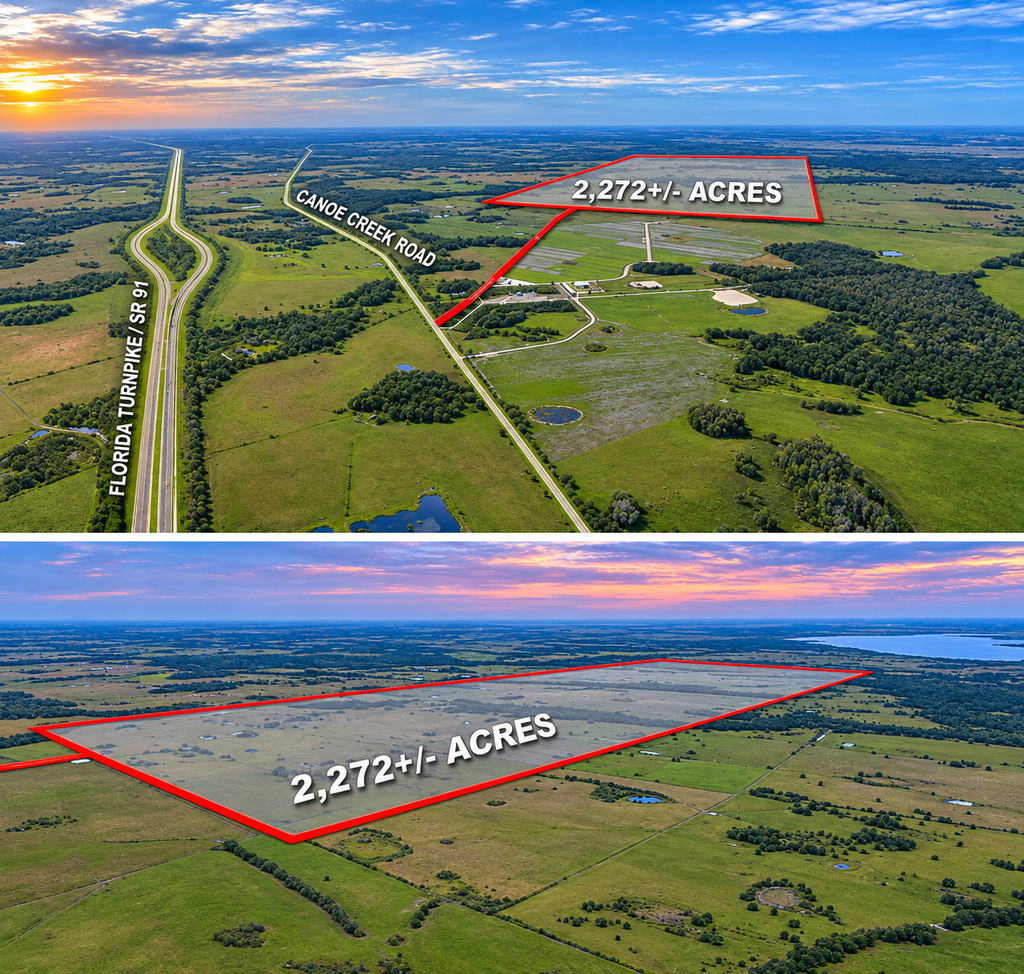
Commercial real estate firm CBRE is marketing a property at 5300 North Canoe Creek Road in Kenansville, near Bar Seven Ranch Road, as a major hyperscale data-center development opportunity.
The listing identifies:
- 2,232 acres of total property, including approximately 1,066 developable acres.
- Access to two Duke Energy 230-kilovolt electrical transmission circuits.
- An initial electrical load study, with an updated study advertised for completion by the end of summer 2026.
- Significant permitted water resources, although specific withdrawal quantities are not provided.
- The potential to receive electricity by early 2028 through a combination of utility-grid power and on-site generation.
These are substantial resources for a proposed industrial development.
However, the listing does not identify a committed data-center operator, disclose the total planned electrical demand, or establish that the development has received the necessary government approvals.
That distinction matters. The site is being marketed for development, but a property advertisement is not the same as an approved construction project.
Just How Much Electricity Could This Data Center Consume?
Hyperscale data centers are fundamentally different from traditional commercial buildings.
A typical office building uses electricity for air conditioning, lighting, computers, and equipment. A hyperscale AI data center can operate enormous concentrations of high-performance computing systems around the clock.
These machines require substantial electricity not only for computing, but also for cooling, electrical distribution, and supporting infrastructure.
The size of the Kenansville property’s potential electrical load has not been publicly established.
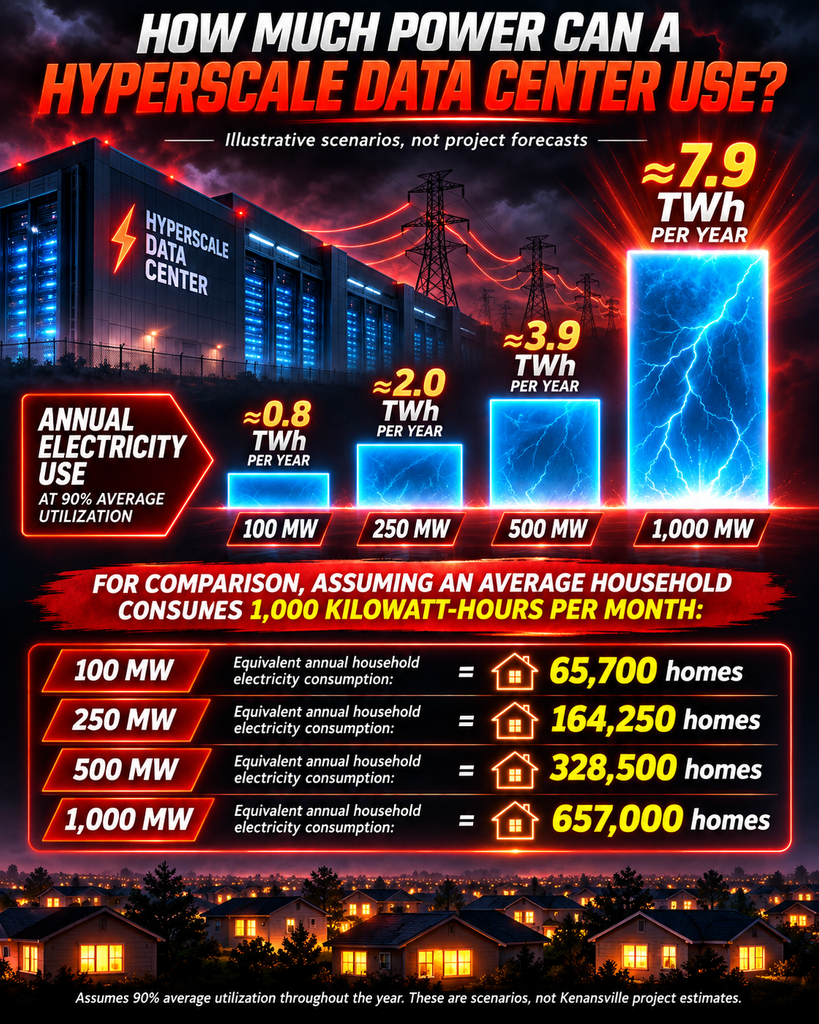
However, consider a hypothetical 100-megawatt data center operating at an average of 90% of its maximum electrical demand.
That facility would consume approximately 788 million kilowatt-hours of electricity annually.
For perspective, that is equivalent to the annual electricity consumption of approximately 65,700 households, assuming an average of 1,000 kilowatt-hours per household each month.
A 500-megawatt facility would consume five times as much electricity under the same assumptions.
These examples illustrate scale. They are not estimates of the Kenansville project’s actual electricity demand.
The real number cannot be determined until the developer or utility releases a credible power-demand study.
The Bigger Question: Who Pays for New Power Plants and Transmission Lines?

This is where the proposed development becomes relevant to Central Florida households far beyond Kenansville.
A hyperscale data center requiring hundreds of megawatts may need more than a connection to an existing transmission line.
Depending on the available capacity, serving the facility could require new substations, transformers, transmission upgrades, or additional electric generating capacity.
Those investments can cost substantial sums, potentially reaching hundreds of millions of dollars or more for major projects.
In a regulated electric utility system, approved infrastructure expenses are generally recovered through customer rates.
That creates an important financial question.
If a utility builds new infrastructure primarily to serve one enormous private customer, should households and small businesses pay any of the costs attributable to that customer?
Florida’s new law is intended to prevent that from happening.
But the issue is more complicated than requiring a data center to pay its monthly electricity bill.
The customer may also need to pay for infrastructure expansion, additional generating capacity, ongoing maintenance, and financial risks associated with its demand.
For example, what happens if a company requests hundreds of megawatts, a utility invests in infrastructure, and the project is later canceled or significantly downsized?
Without adequate financial protections, some of those costs could potentially be stranded and become a problem for other electricity customers.
Why Orlando Residents Should Pay Attention
The effects of utility infrastructure decisions do not necessarily stop at county boundaries.
Duke Energy Florida serves customers across numerous communities and counties. Its regulated costs can be allocated across broad groups of customers rather than charged only to households near a particular project.
Therefore, a Duke Energy customer living far from Kenansville could potentially be affected by costs improperly assigned across Duke’s electric system.
However, this does not mean every Central Florida electric customer would automatically be affected.
Customers served by the Orlando Utilities Commission, Kissimmee Utility Authority, or other utilities are not automatically responsible for Duke Energy’s retail infrastructure costs. Any possible indirect effects would depend on separate wholesale electricity arrangements and other circumstances.
The critical question is not simply where a person lives.
It is which utility serves that household and how the costs of a large industrial customer’s electricity demand are allocated.
Florida Passed a Law to Protect Electric Customers
In May 2026, Governor Ron DeSantis signed Senate Bill 484, legislation addressing the growing demand for hyperscale data centers in Florida.
The law took effect July 1, 2026, and establishes new requirements for utilities serving unusually large electricity users.
Among its key provisions, the law requires qualifying large-load customers to bear their own full cost of electric service, including relevant infrastructure and generating costs.
It also seeks to prevent financial risks associated with those customers from being shifted to other ratepayers.
The legislation generally covers customers with anticipated peak electricity demand of 50 megawatts or more at a single location.
These requirements are important protections for residential customers.
However, passing legislation is only one part of the process. Utilities must develop rates and service agreements that satisfy the requirements, and regulators must determine whether those arrangements adequately protect customers.
Source: Florida Senate, SB 484
Florida Regulators Just Rejected Duke Energy’s Data Center Rate Proposal
A particularly important development occurred on November 3, 2026.
The Florida Public Service Commission rejected Duke Energy Florida’s proposed rate structure for very large electricity customers.
The commission determined that Duke’s proposal did not adequately demonstrate compliance with Florida’s new requirements.
Among the concerns, the proposal did not cover every customer falling within the law’s large-load definition, and Duke had not sufficiently demonstrated that its existing rates and proposed contractual protections would ensure that large customers paid their full cost of service.
Duke must submit a revised proposal.
This ruling was not a decision on the Kenansville property itself. It addressed Duke Energy’s broader approach to serving large electricity customers in Florida.
Nevertheless, it highlights the importance of establishing fair, adequately supported electricity rates before utilities commit substantial resources to large private developments.
For households already dealing with rising insurance premiums, housing costs, groceries, and other expenses, electric rates are an important part of the affordability conversation.
Source: Florida Public Service Commission, Docket 20260064-EI
Where Would the Water Come From?
Electricity is only one of the major resource questions.
Data centers generate substantial amounts of heat, which must be removed to keep sensitive computing equipment operating safely.
Some facilities use evaporative cooling systems that consume water. Others use dry cooling or closed-loop liquid cooling systems that may require substantially less direct water consumption.
The amount depends on the technology, climate, facility design, and operating conditions.
CBRE’s Kenansville listing advertises significant permitted water resources, but it does not disclose exactly how much water could be withdrawn, where the water would come from, or what cooling technology would be installed.
These are important omissions for a rural community where residents and agricultural businesses may depend on groundwater supplies.
Questions about groundwater withdrawals, existing wells, conservation, and long-term water availability deserve careful evaluation before any project advances.
Florida’s new data-center legislation also addresses water use.
Under Florida Statute 373.262, large-scale data centers requesting an average daily water allocation of at least 100,000 gallons must provide additional information about water sources, cooling-related consumption and losses, and water conservation.
The law also requires hearings for large-scale data-center water permits and establishes conditions under which reclaimed water must be used.
These requirements offer a mechanism for public examination of the project’s potential effects on local water resources.
Source: Florida Statute 373.262
What Would Osceola County Gain?
Data-center development can provide economic benefits.
Construction can create jobs, major facilities can expand the local tax base, and investments in utilities and communications infrastructure can support additional economic activity.
However, those benefits must be evaluated against the specific commitments made by the developer.
Large construction expenditures do not necessarily translate into equally large permanent workforces. Data centers can operate with comparatively small on-site teams relative to their physical size and electrical consumption.
For Kenansville, the public has not yet been provided with a confirmed number of permanent jobs, projected tax revenue, infrastructure expenses, or the estimated value of any public incentives associated with a specific development.
Without those figures, it is difficult to assess whether the potential economic gains would justify the associated land, energy, and water demands.
Has Osceola County Approved the Project?
No approval of the proposed data-center development has been established.
In fact, Osceola County issued an important public statement on October 2, 2026.
The county explained that its Board of County Commissioners had unanimously agreed during a June workshop to defer action on large-scale AI data-center proposals until the completion of a state study.
That report is due July 1, 2027 and will examine environmental, economic, energy, public health, and safety impacts.
County officials also indicated that their review could continue beyond that date.
Consequently, the site’s advertised ability to receive electricity in early 2028 should not be interpreted as an approved construction schedule or guaranteed opening date.
Source: Osceola County’s official statement
Questions Residents Deserve Answers To
Before a development of this magnitude proceeds, several questions should be answered publicly.
How much electricity will the entire development require? The public should have access to the anticipated peak demand in megawatts, including estimates for each development phase.
Will Duke Energy need additional power plants or transmission infrastructure? If so, what will those projects cost, and who will finance them?
Can the developer guarantee that residential customers will not subsidize its electricity needs? That assurance should be supported by regulatory filings, cost-of-service calculations, and enforceable financial agreements.
How much water will the facility consume? The source, daily quantities, cooling methods, and potential effects on existing water users should be disclosed.
What happens if the development is canceled? Financial arrangements should protect other electricity customers from infrastructure investments made for a project that never materializes or fails to reach its anticipated operating capacity.
What measurable economic benefits will Osceola County receive? Permanent employment, tax revenue, infrastructure commitments, and any requested incentives should be part of the public discussion.
The Bottom Line for Central Florida Residents
The proposed Kenansville hyperscale data-center opportunity raises questions that go well beyond the borders of one rural property.
Artificial intelligence is driving enormous investments in computing infrastructure, and Florida may become home to more facilities of this kind.
Development can bring opportunities, but those opportunities should be accompanied by transparency about resource consumption, infrastructure requirements, and financial responsibility.
Florida has already recognized the potential problem of shifting large industrial electricity costs onto ordinary households and has enacted legislation intended to prevent it.
The recent rejection of Duke Energy’s large-load rate proposal demonstrates that implementing those protections remains an active regulatory issue.
There is currently no verified evidence that the Kenansville development has increased residential electric bills or that it will necessarily do so.
What remains uncertain is the project’s eventual size, its electricity and water demands, and the details of any future utility agreements.
For Central Florida families, those are not minor technical questions.
If a private company requires enormous new investments in public utility infrastructure, residents deserve to know that the company creating those costs will be responsible for paying them.
That principle should apply whether the facility is built next door or a hundred miles away.
LifeHappens2Us.com will continue examining the proposed Kenansville development, including its potential implications for local communities, electricity affordability, and Florida’s natural resources.
Editorial research note: This article reflects publicly available information reviewed November 10, 2026. Electricity consumption examples are illustrative and do not represent disclosed specifications for the Kenansville property. The property’s marketing status, project details, and regulatory proceedings may change.

Hector
Just a guy with a lot of thoughts on a lot different things. This site is where I can share some of those thoughts. I'm in Defense and Aerospace and we will leave it at that.

You May Also Like

Before You Replace It, Try Fixing It: The Case for Repairing Things Again

Orlando Air Show 2026: F-22 Raptor, Tickets, Times & What to Know